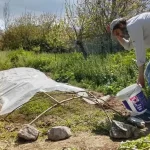
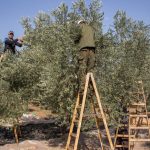
Young people, along with Priscila, collect harvest in the course’s community garden. Photo: Marcus Vinicius, used with permission
This text, written by Felipe Barbosa, Gabrielly Souza, Thauane Blanche, and Thila Moura, was originally published on April 22, 2026, on Agência Mural’s website. It is part of the project “Planeta Território — Tecnologias De Letramento Climático” (“Technologies for Climate Literacy”), carried out by Território Da Notícia in partnership with the Society and Climate Institute (ICS). The article is republished here under a partnership agreement with Global Voices, with edits.
Collectives and organizations from the outskirts of the São Paulo region in Brazil are transforming local realities by uniting environmental education, community mobilization, and practical solutions to face the climate crisis. Areas previously used for trash disposal have become community gardens that today provide food for families. There are also projects to combat deforestation and irregular construction.
Agência Mural spoke with four collectives that work with local people to mitigate the impacts of climate change and promote environmental education in their communities.
Planting and harvesting
In Jardim Lapena, in eastern São Paulo, what was previously an irregular rubbish dump has become a community garden that feeds dozens of families. It was there that Maria Edilene, 39, founded the Coletivo das Marias. “I have the greatest pleasure in telling people that it was not the government that did away with the rubbish,” she said.
The change began about 14 years ago, when Edilene came across a pile of trash bags in front of her house. Annoyed by the exposure of her children and others to toxic materials, bad smells, rats, and insects, she decided to take action. “I refused to raise my children with that rubbish,” she said.
Alone, she began cleaning up the space and mobilized other residents. Initially, seven neighbours joined the effort. Edilene began growing tea on the site, a nod to her northeastern origins. What began organically has, over time, consolidated into an environmental education initiative. “At the time, I didn’t even know it was called that, but people were becoming aware of it,” she said.

Maria Edilene with a lettuce from the community garden. Photo: Coletivo das Marias, used with permission
As the work progressed over the years, the area became a community garden, with the cultivation of vegetables such as lettuce, carrots, beetroot, and radishes, as well as medicinal plants, known as “living pharmacy.”
All production is agroecological, with no pesticides used, respecting nature’s rhythms, and pollination carried out by bees, birds, and butterflies.
The area directly supplies food to 72 families, who participate in a community composting system that uses a biological process to transform organic waste (food scraps, husks, and leaves) into natural fertilizer. After registering, residents contribute organic waste, which is weighed and checked, and, in return, they have access to food from the garden.
For Nathalia Souza, a 30-year-old local farmer, the job represents a change in perspective. “I never imagined that I would leave the Northeast to work with the land [in São Paulo]. Today, I can see the world differently,” she added.
Proximity to family, reduced travel, and contact with the land are among the main positive points. “I learned to connect with nature. It changed my routine, my eating, and the way I see myself.”

Natalia delivers vegetables by bike. Photo: Coletivo das Marias, used with permission
The Coletivo das Marias also has partnerships, such as with Ciclolog, an environmental mobility and communication organization, responsible for the Bike Horta project. The initiative promotes collecting organic waste on bicycles. Families and schools receive buckets for food waste, which are collected three times a week and taken to the composter.
“The partnership with Bike Horta began in 2021, with support for local groups and communication”, said Everton Silva, 35 years old and Ciclolog’s organizer.
Taking out the rubbish
Ionilton Gomes de Aragão, 56, lives five kilometers from the Coletivo das Marias in the Santa Inês community, São Miguel Paulista District. He has been in the neighbourhood for 50 years, following the area change.
“Living in a clean, organized, and bright place improves self-esteem,” said the creator of the Varre Vila (Sweep the Town) project. This is an environmental education initiative intended for public participation. They place bins for organic and recyclable waste at various points in the neighbourhoods. About 34 tons of waste are removed per month.
Residents do the maintenance themselves. “We have not yet reached 100 percent of the neighbourhood, but a lot of the people already understand the importance of our actions. So, we continue with this ongoing environmental education,” said Aragão.

Aragão explaining about appropriate trash disposal. Photo: Diego Monteiro, used with permission.
“It’s almost a [warning] cry: take care of and help take care of the place where you live and work. If the people are not united, it doesn’t work,” he said.
The neighbourhood has made some efforts to raise awareness about waste disposal, which is essential in a region that frequently floods.
“We have heard from residents that, after the floods, the water drained faster and did not leave rubbish floating in the streets,” Aragão said.
“These actions are important because it leads to a change in people’s behaviour regarding the irregular disposal of waste,” he added.
However, despite having established itself, the initiative still faces funding challenges.
Collective solutions
Beyond the more urbanized areas, places with more natural environments also face preservation challenges. In southwestern Greater São Paulo, cities such as Embu das Artes, Cotia and Itapecerica da Serra have 60 per cent of their territory in Water Source Protection Areas (APMs). They are included in the Atlantic Forest natural region.
Rodolfo Almeida, 43, said that working in the region is arduous. He is an environmentalist and advisor to SEAE (Ecological Society of Embu), an NGO that has been active for 54 years in environmental defence across three municipalities.
The SEAE works with socio-environmental projects in schools and local communities and has more than 100 permanent members. It runs educational projects to raise public awareness about the importance of preserving water sources. “That river or spring so close to home needs to be taken care of with the same attention as the water in our homes,” explained Almeida.
The project “Watching the Rivers,” an initiative in partnership with the NGO SOS Atlantic Forest, takes local people to riverbanks and teaches them to assess the condition of the waterways.
The “Conecta Cotia-Guarapiranga” is a technological field guide that maps water sources and forests to inform the monitoring of these natural resources and the development of more effective environmental conservation plans.

People participate in the ‘Watching the Rivers’ project. Photo: EEAS, used with permission
The Guarapiranga Basin supplies more than 4 million people in the São Paulo Metropolitan Region, but is affected by deforestation, irregular occupations, and pollution from untreated sewage.
One of the most recent analyses by “Watching the Rivers” classified the water of the Ribeirão da Ressaca stream, in the Ressaca and Caputera neighbourhoods, on the border between Embu, Cotia, and Itapecerica, as “bad” (high pollution levels and unfit for consumption).
“The indicators show the lack of educational initiatives and political action to ensure efficient sanitation,” Almeida said.
In schools
Environmental education is also one of the goals of 59-year-old environmentalist Adriana Abelhão, vice-president of Preservar Ambiental in Itapecerica da Serra. The NGO, founded in 2009, focuses on fighting deforestation in the Itaquaciara neighbourhood, which has suffered from irregular land use and construction of storage units and landfills. It also seeks ways to bring environmental issues to the community.
“More and more residents of nearby cities come to us for guidance on environmental complaints and environmental education projects,” said Abelhão. “From the resident who loves the tree on their street and wants to protect it, or animal rights activists, to groups of residents who organize themselves to deal with large-scale damage to the environment.”

Adriana Abelhão talks to students about the importance of environmental education in their areas. Photo: Preservar Ambiental, used with permission
The group operates in four state schools through the Conexão Natureza project, which aims to provide environmental education to students and teachers. “We deal with issues such as climate change, water sources, basic sanitation, solid waste, and nature-based solutions. It’s two years of work and four months in each of the four partner schools,” she said.
Teaching about growing plants
At the Pimentas Community Course, a significant portion of the food students and volunteers eat is grown onsite. Located in Guarulhos, in Greater São Paulo, the space brings together 130 young people and 20 volunteers aged 18 to 23. There is a green area, with an orchard, vegetable and medicinal gardens.
The course also maintains a meliponary of bee hives native to the Atlantic Forest, and promotes recycling of materials used by the community. These items are marketed by volunteers, and the income earned contributes to supporting students at universities in rural areas or in other states.
Former student and now volunteer, biologist Marcus Vinícius, 27, points out that the course has become a source of opportunities in a region with few environmental facilities. “It is collective work, done by many hands. We see the results every day,” he said.

Course students taking care of the trees and plants in pots. Photo: Marcus Vinícius, used with permission