‘The Sigh of the Earth’: Fragments from communities overlooked after Venezuela’s earthquakes · Global Voices

The aftermath of the earthquakes in Venezuela in Boca de Aroa, Carabobo state on June 24, 2026. Photo by Saúl Zerpa. Used with permission.

The aftermath of the earthquakes in Venezuela in Boca de Aroa, Carabobo state, on June 24, 2026. Photo by Saúl Zerpa., used with permission.

This article is part of the Special Coverage “Inside Venezuela’s Earthquake Disaster,” where we examine the aftermath of the earthquakes, share stories from the ground, and explore the human impact, recovery efforts, and challenges facing affected communities.

On June 24, 2026, at 6:04 p.m. local time, the earth along the northern Venezuelan coast released its tension in a seismic doublet that primarily struck La Guaira, where the country’s main port is located, and the capital, Caracas. It also affected Valencia and Morón in Carabobo state, and Boca de Aroa in Falcón state, both of which lie along the coastal corridor closest to where the earthquakes occurred.

As news media and social platforms became saturated with images of rubble, rescue workers and volunteers, my project, entitled “The Sigh of the Earth,” began from the opposite premise: to build visual memory from within the lived experience of the event, rather than from its spectacularized epicenter.

Days to come: life changes. What used to be a story told by your parents is now a reality: “If an aftershock is going to knock it down, I’d rather knock it down myself,” said a Boca de Aroa resident as he was dismantling the remains of his home. Photo by Saúl Zerpa; used with permission.

Days to come: life changes. What used to be a story told by your parents is now a reality: ‘If an aftershock is going to knock it down, I’d rather knock it down myself,’ said a Boca de Aroa resident as he was dismantling the remains of his home. Photo by Saúl Zerpa, used with permission.

La Guaira was the state that suffered the greatest devastation. Located just 30 kilometers (19 miles) from Caracas and home to approximately 400,000 people, it was declared a disaster zone by the Venezuelan government. The death toll reached into the thousands, while structural damage, according to the World Bank, was estimated at USD 19.6 billion.

Morón, on Venezuela’s central coast, is located just 21 kilometers (13 miles) east of the epicenter of the main earthquakes. Across several communities, 60 families were affected by the earthquakes, 40 of whom lost their homes entirely. Preliminary reports estimated nine fatalities following the events of June 24.

Boca de Aroa, situated on the eastern coastal strip between Morón and Tucacas, also experienced severe impacts on housing and public services. Initial reports documented 87 damaged homes and 252 displaced residents, as well as soil liquefaction, ground fissures, subsidence, and damage to electrical poles and transformers.

In Boca de Aroa, 128 homes were declared uninhabitable, leaving their occupants vulnerable, without the memories and accumulated experiences the structures previously held. Valuing life is essential, but without a place from which to live it, it can feel as though you have lost it. Photo by Saúl Zerpa; used with permission.

In Boca de Aroa, 128 homes were declared uninhabitable, leaving their occupants vulnerable, without the memories and accumulated experiences the structures previously held. Valuing life is essential, but without a place from which to live, it can feel as though you have lost it. Photo by Saúl Zerpa, used with permission.

Despite this, international attention overwhelmingly shifted toward La Guaira, where the collapse of numerous buildings in densely populated residential and tourist districts close to Caracas and Maiquetía International Airport dominated global news coverage. As a result, many who lost everything remain absent from the public agenda.

Rather than documenting the disaster’s ground zero, the project assembles traces of the earthquake as they persist in everyday life. It brings together photographs of local destruction and housing devastation in Carabobo and Falcón, alongside screenshots of chat conversations, regional maps, and seismological records.

I then wove these materials into a single video, turning “The Sigh of the Earth: Fragments From Communities Overlooked After Venezuela’s Earthquake” into an unconventional documentary project:

The video assembles photographs from affected areas outside La Guaira, including Valencia, Morón, and Boca de Aroa, and combines them with screenshots, maps, and digital visualizations created with a Python-based emulator of Chladni patterns that translated the earthquake’s frequencies into abstract visual forms.

The soundtrack is central to the piece. The film interweaves these visuals with voice messages from family members checking on my safety and an acoustic guitar melody recorded during one of Valencia’s recurring power outages. The result is the construction of a piece of visual memory that resists the overwhelming reproducibility of contemporary disaster imagery.

Bonilla: “I can’t leave this place. I don’t want to leave my house alone.” More than 80 families were affected in Boca de Aroa, Falcón state. Photo by Saúl Zerpa. Used with permission.

Bonilla: ‘I can’t leave this place. I don’t want to leave my house alone.’ More than 80 families were affected in Boca de Aroa, Falcón state. Photo by Saúl Zerpa, used with permission.

Venezuela is an earthquake-prone country. In 2005, Venezuelan researchers and the Japanese government warned of the risks facing the city of Caracas in the event of a major earthquake; 80 percent of the population is concentrated in areas of highest seismic risk.

However, what suffered the greatest damage in the hills of Morón, Carabobo state, was what had been built by the human species. The trees, including the flashes of flamboyant trees, remained intact. It is nature selecting what stays and what goes.

In Venezuela, housing crises, internal migration, and the lack of regulations—as well as the failure to enforce those that already exist—have created complex conditions for responding to natural disasters. Homes in Morón, an area near the coast of Carabobo State, were affected. Photo by Saúl Zerpa. Used with permission.

In Venezuela, housing crises, internal migration, and the lack of regulations — as well as the failure to enforce those that already exist — have created complex conditions for responding to natural disasters. Homes in Morón, an area near the coast of Carabobo State, were affected. Photo by Saúl Zerpa, used with permission.

After these devastating earthquakes, Venezuela is experiencing collective grief. The entire country is cracked, and across digital platforms, genuine expressions from those experiencing this pain have grown. Telling the story over and over again seems to be a way of carrying the pain.
More Recommendations

MediaHack: 36 hours against electoral disinformation in Ecuador · Global Voices - Participants of the Hackathon in Quito, February 22 and 23, 2025. Credits: Ruben Zavala (Openlab). Photo used with permission. A […]
Solidarity fields in Syria: Reviving local seed production · Global Voices - The Solidarity Fields in Jaramana initiative is an extension of the “Solidarity Fields and Dignity” project. Picture by Lahlah. Used […]
Haiti’s ‘Grenadiers’ bring hope and joyful moments at World Cup 2026 · Global Voices - Feature image created by Janine Mendes-Franco using Canva Pro elements. Haiti has not played in the final phase of a […]
Support Global Voices as we launch our donation campaign · Global Voices - Members of the Global Voices community at the GV summit in Kathmandu, Nepal, in December 2024. Photo by Jer Clarke. […]
Australia’s Budj Bim features one of the world’s oldest aquaculture systems · Global Voices - Screenshot from ‘World Heritage Nomination – Budj Bim Cultural Landscape’ by YouTube user Gunditj Mirring. Fair use. Australia has one […]
‘Indigenous languages and cultures are surviving, and will continue to survive’: Interview with Juang-language writer Kshetrabasi Juanga · Global Voices - Kshetrabasi Juang being interviewed by Opino Gomango in Mysore, India. Image by the author. This post is part of Global […]
The key to saving potato cultivation amid climate disruption in the Democratic Republic of the Congo · Global Voices - CAPSA Luotu seed potato repository. Image by GreenAfia GreenAfia first published this article on September 10, 2025. Global Voices republished […]
Inside Bangladesh’s Rohingya camps where fire continues to shape the existence of refugees · Global Voices - Volunteers and workers clear debris from blackened ground following a devastating fire in Camp 11 on February 13, 2026, at […]
Australia’s Brewarrina fish traps may be the oldest human construction in the world · Global Voices - Brewarrina Fish Traps October 2025 – author’s photo Australia has two of the world’s oldest aquaculture sites, where fish and […]
When women organise, democracy survives: Why gender justice cannot be a casualty of global crises · Global Voices -   Women Celebrating International Women’s Day in Mexico City, Mexico, March 2023. Photo by Miguel González on Pexels. By Christelle […]
Turkish tennis player Zeynep Sönmez leaves Wimbledon with pride · Global Voices - Feature image created by Arzu Geybullayeva using Canva Pro. She left Turkey full of pride, for all the right reasons: […]
‘Galician identity and literature are deeply rooted in land,’ award-winning Galician writer explains · Global Voices - Galician countryside. NoelFeans/Flickr under licence CC BY 2.0. Every May 17, the autonomous region of Galicia, Spain, interrupts its routine […]
Brazil will feature the number 24 on the pitch during World Cup 2026. And that carries a message · Global Voices - Art created by Global Voices on Canva Pro This post is part of Global Voices’ June 2026 Spotlight series, “Gender […]
Africa’s ambitious push for vaccine independence · Global Voices - A nurse at Bukakata Health Centre III in the southern Uganda district of Masaka is administering an oral vaccine to […]
When Chinese parents outsource control over their adult children · Global Voices - Young adults are forced to do physical exercise inside a behavior correction facility. Screenshot from BBC Chinese’s YouTube Channel. On […]
Palestinians are being locked out of the digital economy · Global Voices - Screenshot from video ‘Gaza’s electricity crisis deepens as Israeli strikes threaten vital solar panels,’ uploaded to YouTube by Al Jazeera […]
Before the algorithm decides: Queer storytelling as resistance in Nigeria · Global Voices - Still from the film ‘ìfé,’ used with permission. By Pamela Adie This post is part of Global Voices’ April 2026 […]
Countless endangered species are making a comeback due to global conservation efforts · Global Voices - An Amur leopard (CC BY 2.0), a coral reef (CC BY 2.0), and two greater one-horned rhinoceroses (CC BY-SA 4.0). […]
Seeking independence from Chinese exports, Brazil enters bid to explore rare earths · Global Voices - Powdered rare earth minerals. Image from Wikimedia Commons, license: public domain. For the past decades, China has undoubtedly dominated the […]
Year in Review: How the Caribbean survived 2025 · Global Voices - Feature image via Canva Pro. The year had started hopefully enough, what with Trinbagonian steel pannist Joshua Regrello registering his […]
No safety, no way out: The Rohingya girls caught between aid cuts and child marriage in Bangladesh · Global Voices - Inside a Bangladesh refugee camp, a classroom of Rohingya children sing English songs at a UNICEF learning centre, funded by […]
How Europe ships its waste to Morocco and calls it ‘recycling’ · Global Voices - Image by UntoldMag, used with permission By Khalid Bencherif and Federica Rossi This story, by Khalid Bencherif and Federica Rossi, […]
The human cost of the data center push in Latin America · Global Voices - A data center. Image via Canva. This post is part of Global Voices’ April 2026 Spotlight series, “Human perspectives on […]
AI-ready data centers are booming in Indonesia but water woes loom · Global Voices - Nongsa Digital Park in Batam, Indonesia. Screenshot from YouTube video of Channel News Asia. Fair use. This post is part […]
What has become of Mauritania’s fishermen fifteen years after the authorities signed an agreement with China? · Global Voices - Women wading out with baskets to meet a fishing boat in the shallows, to buy the fresh fish at Port […]
Nationalistic performance versus Bushido traditions: Debates over Japanese cleanup at the 2026 FIFA World Cup · Global Voices - Trash bags used by Japanese fans during the 2026 World Cup. Screenshot from the YouTube channel of user @taiyojr.10. Fair […]
In Brazil, initiatives in peripheral communities seek to expand environmental education · Global Voices - Young people, along with Priscila, collect harvest in the course’s community garden. Photo: Marcus Vinicius, used with permission This text, […]
When dry season never ends · Global Voices - An aerial photo of Guanacaste, Costa Rica. Image from Photo by Jean Paul Montanaro via Pexels. Free to use. Water […]
Too afraid to leave home: ICE’s toll on Latino HIV care in the United States · Global Voices - Albé Sanchez. Photo by Liam James Doyle for Uncloseted Media and Rewire News Group. Used with permission. By Sam Donndelinger […]
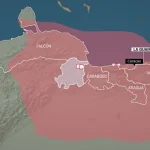
Why Venezuela’s earthquakes were so devastating: Geology, vulnerability, and years of structural neglect · Global Voices - Map of the earthquakes’ impact across seven Venezuelan states, highlighting Ground Zero: La Guaira. Screenshot taken from the YouTube video […]
Scroll to Top