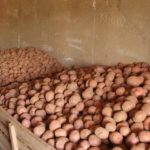
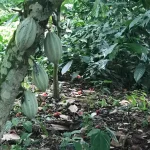
An Indonesian farmer checking on a durian. Image from YouTube screenshot. Fair use.
This article was submitted as part of the Global Voices Climate Justice fellowship, which pairs journalists from Sinophone and Global Majority countries to investigate the effects of Chinese development projects abroad. Find more stories here.
Indonesia is expected to reach a trade deal later this year to export whole durians to China, where the tropical fruit has gained a huge following. Farmers and investors are expanding cultivation, anticipating this landmark agreement to open a new and lucrative market for Indonesian durians.
Durian, a spiky and pungent tropical fruit, can be found in many Southeast Asian countries. Its distinctive, pungent smell has led to bans of the fruit in public places in several Asian countries, but its sweet taste has also earned huge popularity across Asia. Nicknamed “king of fruit,” durian is known to be an exceptionally high-value crop. It can sell for anywhere from USD 5 to hundreds of US dollars per kilogram, depending on the variety.
In China, the demand for durian has skyrocketed in recent years, especially among young consumers. Durian has gone viral on live streaming platforms where customers can select and order the fruit online and have it delivered within 72 hours. China’s obsession with durian spreads far beyond the fruit itself, as its distinctive flavor can now be found in desserts, chicken hot pots, barbecue, burgers, pizza, and more. Durian-themed restaurants have even sprung up in major cities.

A Vietnamese farmer harvesting durians. Image from YouTube screenshot. Fair use.
In 2024, China imported approximately 1.56 million metric tons of durians with a total value of USD 6.99 billion, hitting a record high. The country takes in 95 percent of global durian exports, mostly from Thailand, Vietnam, and Malaysia. With the anticipated direct durian export to China, Indonesia is presented with an opportunity to catch up to the competition.
A sweet deal
In Indonesia, durian has long been an integral part of the country’s food culture. With a diverse range of durian species, the country produces around 2 million tons annually — the largest in the world — but most of its durian yield is consumed domestically.
The Indonesian government has tried to attract Chinese investors in the durian sector. In 2023, the country’s Chief Investment Minister Luhut Binsar Pandjaitan stated that Indonesia would provide 5,000 hectares of land in North Sumatra and Sulawesi Island to potential Chinese durian investors. He did not name the specific locations but suggested one of the potential sites could be in Humbang Hasundutan Regency, an area in North Sumatra rich in forestry and famous for coffee production.
As outlined in this proposal, 70 percent of the yield would be directed toward the Chinese market, while the rest would be for domestic consumption. Pandjaitan also disclosed that the then-Indonesian president Joko Widodo had brought up this durian investment scheme to his Chinese counterpart Xi Jinping during a dinner meeting in Chengdu.
Though this investment proposal has not materialized, the two countries have continued to explore durian trade. During a state visit to China in 2024 by the newly elected Indonesian President Prabowo Subianto, the two countries agreed to a protocol for coconut exports from Indonesia.
“We’re still working on durians and I don’t think we are very far from that,” said Chinese Ambassador to Indonesia Wang Lutong, according to Channel News Asia. “The Chinese consumers love Indonesian food (and) fruits, and we see a lot of market access to China.”
Observers say Indonesia’s durian trade deal with China is sweetened by close diplomatic ties between Beijing and Jakarta. The year 2025 marked the 75th anniversary of the establishment of diplomatic relations between China and Indonesia, as well as the 70th anniversary of the Bandung Conference held in Beijing, a milestone celebrated by both governments.
Currently, Indonesia only exports durian paste to China, which is more complicated to produce and less profitable than the fruit itself. Frozen durians are also re-exported to China via Thailand, significantly reducing potential profits for Indonesian growers. The upcoming trade agreement will cut transportation time and expense and establish a direct supply chain to the most lucrative market.

Durians from Indonesia. Image from YouTube screenshot. Fair use.
If Indonesian durians reach fruit shops in China, “I might first go and try one,” Zhao Yu, a 38-year-old finance professional based in Shanghai, told South China Morning Post. “I would definitely look first at the prices.” Chinese consumers like Zhao are hoping that Indonesian durians would bring down the market price in China, leading to “durian freedom” for fans of the fruit.
Support Global Voices as we publish more articles like this one
For more information about this campaign, please go here.
Indonesia’s durian rush
It takes at least five years for durian trees to bear fruit, but they can live up to a hundred years, generating lucrative returns each year. The high economic value of the fruit and China’s recent durian boom have motivated many to invest in cultivation in Indonesia, including investors from China.
Catur Dian Mirzada, a durian expert and member of Durian Traveler, an initiative by Indonesia’s Ministry of Agriculture to explore local durian diversity, told Global Voices:
Palu (di Sulawesi Tengah) adalah sentral produksi durian terkenal di Indonesia, karena banyak yang menanam Montong di sana, dan banyak investor China yang melirik ke Palu. Saya dengan sudah ada 30-an pergudangan yang investor mau investasi di sana, jadi sekarang saling berlomba-lomba.
Palu (in Central Sulawesi) is currently the best-known durian production hub (in Indonesia), especially for Montong durians, and investors from China are eyeing for it. I’ve heard 30 warehouse investors are lined up. So we’re in a race [with Chinese investors] now.

A Chinese traveler buys durians in Indonesia. Image from a Douyin (China’s YouTube equivalent) screenshot. Fair use.
Indonesia’s durian does not have the international fame possessed by competitors from Thailand and Malaysia, but the archipelagic country stretching along the equator has a geographic advantage. Awang Maharijaya, a professor of agriculture at Bogor Agricultural University, told Global Voices.
Indonesia itu mampu menghasilkan durian dengan musim panen yang berbeda-beda di setiap lokasi. Sehingga Indonesia itu bisa dianggap ada durian terus sepanjang tahun gitu.
In Indonesia, durians can be harvested in different seasons depending on the location, so Indonesia can be considered to have durian available all year round.
Durians in Indonesia used to be planted in local residents’ backyards, and large-scale durian plantations only started to spring up around ten years ago, Maharijaya told Global Voices. Direct access to the Chinese market will likely further boost the transition to industrial cultivation.
However, Maharijaya and Mirzada both think that Indonesia has a long way to go before its durian sector becomes more standardized and regulated, in order to produce high-quality durians and tap into the massive Chinese market. Mirzada told Global Voices:
Tantangannya bukan di kuantitas, kuantitasnya saya yakin cukup. Cuma masalahnya adalah konsistensi dan kualitas. Masih panjang perjalanannya. Kalau saya belum, 10 tahun juga berkembang juga belum sampai ke sana mungkin. Kita edukasi terus, bagaimana merawat tanamannya, airnya harus dicukupi, dipupuk, disemprot, dan seterusnya.
The challenge is not quantity. We have enough. It’s about consistency and quality. It’s a long journey ahead. I’d say it’ll take about ten years of development. We’re still in the education phase — educating [growers] on how to care for the trees, ensuring there’s enough water, proper fertilization, pest control, and so on.
The bitter side of the sweet fruit
When China, the world’s second-largest economy and second-most-populated country, develops a new craving for durian, Southeast Asian countries are mobilized to secure their pieces of the sweet pie. In Thailand, the size of durian orchards has tripled in 12 years. In Vietnam, coffee farmers are switching to growing durian, as some estimate the crop is five times more profitable than coffee.

A man cutting open a durian in a Thai fruit market. Image from YouTube screenshot. Fair use.
China’s durian craze has created a huge economic opportunity for the region, but it has also led to thorny environmental and social problems. In Malaysia, jungles have been razed to make way for durian plantations, reportedly resulting in deforestation and encroachment on Indigenous land. There’s also a risk of harming endangered animals, as the best lands to grow durians are also the natural habitat for some of Malaysia’s most endangered species, such as the Malayan tiger.
In Laos, where industrial durian cultivation has only started in recent years, Chinese investors have swarmed into the landlocked country, as Laos is poised to begin durian exports to China, and the Laos-China railway (a Belt and Road Iniative project) provides fast transport for the easily perishable fruit. Chinese investors have acquired large plots of land to grow durians, and in some cases, they have cleared primary forests to make room for durian trees. He Ruijun, deputy manager of a Chinese company called Jiarun, which has pledged to build the world’s largest durian plantation in southern Laos, said:
里面就是一片净土,其实我们也挺舍不得的,要把它开发出来。但是我们是想把它弄成经济价值更高、也很好看的一片经济林,让当地的村民和老挝政府能够快速地发展。
It’s an untouched land. We were reluctant to develop it. But then I think the ‘economic forest’ can be just as beautiful, and that it can bring economic growth to the villagers and the Lao government.
Mirzada says compared to crops known to cause environmental damage, durian has a smaller ecological footprint.
Semua tanaman apapun yang dibudidayakan, mereka punya resiko lingkungannya, seperti kentang, tomat, cabai, kubis, mereka pun juga punya resiko. Jadi saya bilang masih aman (durian). Karena kita kan menanam pohon juga, menanam pohon berarti bermanfaat bagi lingkungan kan.
Every cultivated crop has environmental risks. But I’d say durian is relatively safe. We’re planting trees, after all, which also benefits the environment.
But other experts warn that durian trees can never fully replace primary forests. “Some aspects of a monoculture plantation appear similar to a forest, but the biodiversity is much lower,” said Miles Kenney-Lazar, a scholar at the University of Melbourne regarding plantations in Southeast Asia. The plantations also risk local villagers’ access to forest food vital to their livelihood, such as mushrooms and bamboo shoots, he told Nikkei Asia.
Prof Maharijaya believes that durian orchards could play a role in protecting the environment if designed and managed scientifically, if, for example, durian trees were planted alongside plants that attract pollinators.
Sesuatu kalau yang awalnya lahan liar gitu, kemudian kita monokulturkan itu kan bentuk semua hal punya resiko kan. Misalkan biodiversitasnya berkurang atau yang lain-lain. Tapi begitu kita tanam dengan baik … tidak harus kita bilang hitam putih ya, yang satu rusak, yang satu enggak gitu. Jadi memang kalau dikelola dengan baik tentu ada jalan tengahnya.
If the (plantation) area was previously uncultivated land, and we turn it into a monoculture, of course, that carries risks, such as reduced biodiversity. But if we plant properly… it doesn’t have to be black and white — one side destructive, the other not. If managed well, there’s a middle ground.