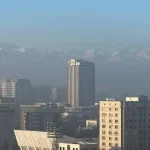
Pollution on a Lagos street, Nigeria. Image by Boluwatife Oguns via Unsplash. License: Free to use.
Nigerians are currently facing severe heat stress. The extreme heat has caused widespread distress, with many social media users reporting that it is affecting their health and reducing their productivity.
According to the Nigerian Meteorological Agency (NiMet), the heat stress is occurring because March falls in Nigeria’s peak transitional heat window — after the Harmattan dry season ends but before the rainy season begins. The heat is affecting people in many parts of the country, but it is more pronounced in the north-central, north-west, and north-east regions, as well as inland areas of the southern states.
Impact of the heat stress on Nigerians
Global Voices spoke to some Nigerians to understand how heat stress is impacting their communities, work, and everyday life.
Onyekachi Ogbu is an Igbo-language consultant and AI data specialist. He lives in Enugu, Nigeria. He explains how the heat stress is affecting his productivity:
It makes it difficult to work, especially for a person like me who works from home. We don’t use the regular power supply in my house. We rely on solar power and a power generator for power, but the solar power does not last for 24 hours. So, we majorly use it when the sun is shining from peak from 9 am to 12 pm or 1 pm. We use it mostly at night, and we can not use it to power fans because it is incapable of powering fans. So, we mostly rely on natural air entering the house from the windows. It’s only when we are on the power generating set that we can use the ceiling fans. Because of the heat, it is hard to work indoors. Sometimes, I would have to work on my laptop outside to get fresh air as I work.
The heat is also causing distraction. Imagine having a virtual meeting, and you have to be fully clothed, and you are sweating heavily as the meeting is ongoing. It will cause distraction because you won’t be comfortable because you can’t take off your clothes while having virtual meetings.
What I rely on to work easily these days is to use hand fans or step outside of the house. On some occasions, I buy fuel for the generator, but I cannot afford to do this every time because fuel price is high.
I believe everyone is feeling the heat stress, but many people in rural areas have limited awareness about it. That’s why we need to create awareness for them to take safety precautions such as staying hydrated and being well-aerated.
Adewale Afolabi, a commercial rider in Osogbo, Osun State, Nigeria, said the heat is unbearable:
The heat is too much and it is affecting my work, but I must continue working in order to take care of myself and my family.
Muh’d Tasi’u Jibril, a linguist living in Bauchi, narrates how the heat is affecting people living in the Northern part of the country:
The heat has been unbearable for the last two weeks. As for a remote worker like me, I cannot work around 11pm to 3pm due to the unbearable heat. The heat was too much during the last ten days of Ramadan. It was so hot that people suffering from ulcer had to break their fast.
Normally, over here we used to experience the harmattan season during the months December, January and February. But this year there is nothing like that.
The heat did not affect my daily work since I work remotely. It is just the epileptic power supply that is making me feel the heat because you won’t be able to use ACs and fans. I hardly sleep at night. I only sleep when I am able to find an alternative source of power to power fans and ACs. Also, it is difficult to get cold water to drink in this period because there is no electricity. What we used to do to cope with the heat stress at night is sleep outdoors, but we can no longer do that due to insecurity. It’s only those who can afford solar panels that can power fans or AC that are not affected by the heat stress.
Nigeria’s power crisis worsens the situation
The country’s deteriorating power supply has made the situation worse. The National power grid has collapsed many times in 2026. This has led to nationwide blackouts, which have made it difficult for many citizens to cope with the heat stress. Due to the power cut, many Nigerians cannot use electrical appliances such as fans and ACs that could provide relief. On March 24, the Minister of Power, Adebayo Adelabu, apologized to Nigerians for the frequent power outages.
Adesewa Popoola, an entrepreneur in Lagos, explained how the crippling power supply has worsened the situation:
I live in a neighbourhood where there is not much space between houses, and because there is no adequate ventilation in the houses in the area. I have noticed a significant change in the temperature pattern over the years. December is supposed to be the Harmattan season, when it might be hot during the day and cold during the evenings. But there was no Harmattan in Lagos throughout December and January. The temperature is always hot throughout the day. The heat has affected my work and daily life. There are times I need to go out and do some things. Once the time is past 10a.m. I won’t be able to go out, because of the extreme heat. I only go out when I am able to get a ride to my destinations. On many occasions, I have to wait till evenings when the heat has reduced before going out If I am unable to get a ride.
If I have an appointment, I have to be mentally prepared for coping with the heat. It is also affecting the way I dress. I am unable to wear some of my clothes because of the heat.
In order to cope with the heat, I stay indoors most times, bath as many times as I can, and drink water regularly.
About awareness, I think most people are not aware of the risks of the heat.
We all know the current situation of electricity in Nigeria. Due to epileptic nature of the power supply, it is difficult to cope with the heat, especially during nighttime when the heat is intense. Since there is no power, many people cannot turn on their fans. To make the matter worse, a lot of people cannot afford to buy fuel because of the hike in the price of fuel. It would have been easier to cope with the heat stress if the power supply is stable.
Cause of the heat wave and recommendations
Researchers have attributed the cause of the heat stress to climate change.
Earlier in March, the Nigerian Meteorological Agency (NIMET) issued a nationwide alert, warning the general public about the health risks the heat stress may pose in some parts of the country. The agency also warned the public to take necessary precautions to reduce their exposure to the heat. In the X post, NIMET encouraged Nigerians to drink plenty of water to stay hydrated, stay in well-ventilated or air-conditioned rooms, wear light, breathable clothing, and wear hats, sunshades, and sunscreens. It advised parents to keep infants cool and hydrated, and never leave children in a closed, parked vehicle.
People are hoping the rainy season starts soon to ease heat stress.