Dimash performing Kazakhstan’s national anthem. Screenshot from the video “National Anthem of the Republic of Kazakhstan – Dimash Qudaibergen” from Dimash Qudaibergen YouTube channel. Fair use.
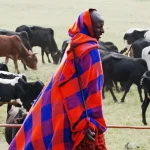
Joy is a young lady from California, wearing a traditional robe called a shapan and speaking Kazakh, a language she began learning three months earlier. This scene took place in London, leading up to the concert of Kazakh singer Dimash Qudaibergen at the OVO Arena Wembley on November 12, 2025.
Dimash’s father and producer, Kanat Aitbayev, met with Joy and recorded their conversation, illustrating a striking reality: Joy had traveled across the world to hear Dimash sing live.
Thousands of fans from dozens of countries follow him across continents, drawn by not only his vocal abilities but by something deeper. Today, Dimash is arguably the best-known Kazakh singer outside his homeland and has reached world fame that no other singer from Kazakhstan has even come close to reaching.
This phenomenon raises a question: what lies behind Dimash’s astounding success?
A musical family
Born in 1994, Dimash became an internationally acclaimed singer early in his career. He is celebrated as a cultural ambassador for Kazakhstan, admired for his vocal talent.
Dimash’s story begins in Aktobe, a small city in western Kazakhstan. His parents are established figures in the region’s cultural life. His father, Kanat Aitbayev, is a songwriter, composer, and singer. His mother, Svetlana Aitbayeva, is a professional singer. Both have held public roles and received the title “Honored Worker of Kazakhstan.”
In 2014, Dimash graduated from the Zhubanov Music College. In 2018, he completed his master’s degree at the Kazakh National University of Arts.
His most remarkable asset is his voice, which spans more than six octaves, moving across this range with impressive ease. This talent, supported by his parents’ professional background and network, carried him onto big stages.
A pivotal opportunity arrived in 2016, when Kazakh journalist and producer Yertay Nusipzhanov invited Dimash to audition for the Chinese show “Singer,” a singing competition show.
During the 2017 run of the show, his vocal performances brought him popularity among the Chinese audience, and the runner-up finish became a stepping stone in his career.
Here is a YouTube video of Dimash performing the French song “S.O.S. d’un terrien en détresse” at Singer.
While he primarily perfoms in Kazakh, his mother tongue, he has quite the linguistic range and has reportedly performed in at least 16 languages, including English, Mandarin, Russian, French (as demonstrated above), Italian, Ukrainian, Turkish, Serbian, Kyrgyz, German, Spanish, and more.
His popularity soon expanded beyond Kazakhstan and China. In 2019, he embarked on his first world tour, Arnau, performing in Kazakhstan, Russia, the US, Latvia, and Ukraine.
The “Dears”
Dimash’s second world tour, Stranger (2022–2025), took him across thirteen countries and was a big success. In Mexico, for instance, two shows sold out in eight minutes, driven by the support of his fans, the “Dears,” who attend Dimash’s concerts and spread his music worldwide.
Here is a YouTube video with the recap of the concert in Mexico.
Last year, one of the Dears from Switzerland, Esther Uhlmann, published a book in English and Kazakh about Dimash’s music.
“My fans treat me with great love and respect… so I chose this word — ‘Dears’,” Dimash explains, highlighting the special connection with his audience.
Indeed, Dimash has earned the admiration of his fans through his warm and respectful attitude. He takes the time to sign autographs, pose for photos, shake hands, and hug them.
One example of this was at his Barcelona concert in November 2025, when he invited a young Kazakh girl wearing traditional dress onto the stage to sing one of his songs with him.
Dimash likely understands what it means for young, aspiring singers to share the stage with him and feel his encouragement.
His caring nature is seen most clearly within his family. He guides his younger brother, Mansur. Since Dimash’s first world tour, Mansur has shared the stage with him, playing the guitar and dombra, the national instrument of Kazakhstan.
He is just as attentive to his sister Raushan — whether supporting her restaurant Daididau or performing a song at her uzaty, a traditional pre-wedding farewell celebration.
Here is a YouTube video with Dimash performing at his sister’s wedding.
As Kazakh journalist Akdidar Abdimaulen observed, Dimash has cultivated the image of a “true artist,” not merely a “commercial product.” Perhaps this is because his personal qualities — modesty, family devotion, and humaneness — resonate universally across borders and nationalities.
A transcendent artist
Dimash’s popularity within Kazakhstan can also be understood in light of the country’s historical experience. After more than two centuries under Tsarist and later Soviet rule, Kazakhstan gained independence in 1991 and has since continued to establish and explore its national identity.
Within this ongoing process, shaped by postcolonial sentiments, Dimash’s public image remains meaningful for locals. Speaking to Euronews in 2024, he described his mission as “introducing the country’s culture and traditional music to the world.”
Music, indeed, serves as a national emissary of sorts. His performance of the folk song Samaltau, portraying the hardships faced by Kazakhs conscripted into labor battalions in 1916, educates foreign listeners about this painful period in Kazakhstan’s history, interwoven with a beautiful composition and melody.
At the same time, Dimash’s rapid musical ascent did not go unnoticed by Kazakhstani officials. “Dimash Kudaibergenov has become a global star, bringing our country’s culture to the world,” stated President Kassym-Jomart Tokayev, following his appearance on “Singer.” Since then, the state has consistently recognized his work and applauded his efforts.
In 2019 and 2023, he received the highest state honors, “Honored Worker of Kazakhstan” and “People’s Artist of Kazakhstan,” respectively. At the turn of 2024, after presidential congratulations on national TV, Dimash performed the national anthem at Akorda, the presidential residence: an event widely read as an endorsement of his status at the highest level.
Here is a YouTube video of Dimash performing the national anthem.
However, this high-level state recognition has not prevented the singer from occasionally making carefully framed but critical political statements — commentary that is generally not welcomed in an authoritarian state.
During the mass protests in Kazakhstan in January 2022, he stated on social media that “people are having a hard time.” He also called on “competent people in power” to “make appropriate decisions quickly.”
Yet Dimash appears aware of the limits of political expression and does not cross established boundaries. In many respects, he adopts a restrained, almost diplomatic posture in his public statements.
This approach became visible in 2022, following Russia’s invasion of Ukraine. Dimash excluded Russia from his touring schedule, despite his previously close ties with the Russian music industry.
In September 2022, at a concert for the Congress of Leaders of World and Traditional Religions, he debuted “The Story of One Sky.” The lyrics are staunchly anti-war and seemingly reference John Lennon’s iconic song, “Imagine,” which has long been hailed as a masterful peace anthem.
Here is the official music video of the song.
Later, Dimash’s appointments as a Goodwill Ambassador for the International Organization for Migration at regional and global levels in 2023 and 2025, respectively, reinforce the link between his artistry and humanitarianism.
Ultimately, Dimash’s rise cannot be reduced to a single explanation. Despite his extraordinary vocal capabilities, his repertoire, often drawing on traditional music and operatic styles, does not fit into conventional “pop” categorizations and may not be appealing to younger audiences.
Yet his artistic identity continues to attract thousands of fans, like Joy from California and Esther from Switzerland. The answer may lie in the way Dimash engages with diverse audiences: through deep human connection and, perhaps, a wisdom beyond his years.