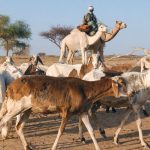
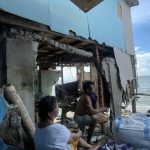
A market in Somalia. Image by Jjumba Martin for Mercy Corps.
As of May 2026, Somalia, a country with a population of over 20 million, is facing one of the worst food crises in its history. According to a new analysis published on May 14, 2026, by the Integrated Food Security Phase Classification (IPC), six million people are experiencing high levels of acute hunger. The IPC is an innovative global multi-stakeholder initiative designed to improve food security and nutrition analyses for informed decision-making.
There are multiple mutually reinforcing causes: consecutive below-average rainy seasons, a security situation that hinders humanitarian aid distribution, and the U.S.’s conflict in Western Asia and its impact on fuel prices and foodstuffs.
A crisis compounded by climate change
Somalia, the easternmost country in Africa, has an arid and semiarid climate. The country contends with four seasons: two dry seasons (Hagaa and Jiilaal) from July to September and from December to March; and two rainy seasons (Gu and Day) from April to June and from October to November. However, in recent years, insufficient rainfall during rainy seasons has caused widespread ecological and agricultural issues.
This insufficient rainfall has weakened herds, reduced harvests, and dried up water supplies, depriving pastoral and farming families of their main sources of income and food.
According to Radio France Internationale, the livestock trade, a major source of this country’s foreign exchange earnings, remains operational despite considerable tensions.
Armed conflicts caused by the State’s collapse, clan rivalries, arms proliferation, corruption, and a rise in armed groups, like Al-Shabaab, persist in several regions of the country, and have also caused food and aid disruptions. These circumstances, therefore, hamper humanitarian organizations’ access to the most vulnerable.
According to the latest IPC analysis, six million Somalis are facing high levels of acute hunger (IPC Phase 3 or above), including more than 1.9 million in Emergency Phase (IPC Phase 4). In a UNICEF publication, following a trip to Dollow, a town in the southern region of Gedo, southwestern Somalia, Executive Director Catherine Russell, stated:
L’une des images les plus bouleversantes qu’il m’a été donné de voir est celle de rangées de lits où se trouvent des enfants malnutris et des mères anxieuses qui espèrent seulement que leurs enfants survivront. La population est incroyablement résiliente, mais elle a besoin de davantage de soutien au plus vite, d’autant que tous les signaux d’alarme sont au rouge, notamment du fait des répercussions de la guerre au Moyen-Orient.
Rows of beds with malnourished children and anxious mothers just hoping their children would survive are one of the most heartbreaking scenes I’ve ever witnessed. Although people are incredibly resilient, they urgently need more support. All the alarm bells are ringing, mainly due to the conflict in Western Asia.
In the Burhakaba district of the landlocked Bay region in southern Somalia, more than one in three children under five years old suffer from acute malnutrition. Consequently, humanitarian workers warn that this area could officially fall into famine by June without any large-scale emergency intervention.
Nationally, 1.88 million children are expected to require treatment for acute malnutrition in 2026. Although the early mobilization of funding averted an official famine declaration in these districts in 2022, this window of opportunity is rapidly closing.
Hormuz shock: A distant crisis with close-to-home consequences
The crisis in the Strait of Hormuz, which began on February 28, 2026, has directly impacted prices in Somalia. Before the conflict, around one-fifth of the world’s crude oil passed through this strait. As a country largely dependent on basic commodity imports, Somalia is particularly vulnerable to international supply chain disruptions. This blockade also hampers the delivery of humanitarian aid and fertilizers, as Catherine Russell highlighted.
In March 2026, fuel prices jumped by 150 percent in Somalia, rising from USD 0.60 to USD 1.50 per liter, stalling the delivery of water, foodstuffs, and humanitarian aid. In the areas hardest hit by drought, the price of a jerrycan of water has risen from USD 0.06 to USD 1.50, a rise of over 2,000 percent in just one year. In the Mudug region (central Somalia), transport costs have also risen by up to 50 percent, forcing entire families to forgo healthcare.
The country also imports 30 percent of its fertilizers from Western Asia. This crisis struck during the agricultural input purchasing period for the Gu season, the Horn of Africa’s main rainy season (as mentioned above). According to the French media outlet Le Grand Continent, the impact on Somalia’s 2026 harvests is now largely irreversible.
Sharp decline in humanitarian funding
Compounding this situation is a particularly severe humanitarian funding deficit. According to Doctors Without Borders (MSF), in April 2026, out of the USD 1.42 billion required for Somalia’s intervention plan, only USD 288 million was allocated, about 20 percent of the total required. Ultimately, a 75 percent reduction to this plan is a direct consequence, lowering the number of beneficiaries from six million to 1.3 million. As a result, more than 200 health and nutrition centers have closed since early 2025, depriving 1.7 million people of essential care.
Read more: Crumbling of the global aid sector
Halima, a Somali woman, quoted in an MSF publication, explained that she attended Mudug’s regional MSF-supported hospital because its medical services are free. She explained:
Je suis venue ici car les services sont gratuits. Sans cela, je n’aurais pas pu obtenir de soins pour mon enfant.
I came here because the services are free. Otherwise, I wouldn’t have been able to get healthcare for my child.
Referring to the transport costs, which have become unaffordable for her, she continued:
C’est devenu beaucoup plus coûteux et difficile qu’avant », déclare-t-elle. « Beaucoup de gens sont désormais contraints de parcourir de longues distances à pied, simplement pour accéder à des soins de santé.
It has become a lot more expensive and challenging than before. Many people must now walk long distances just to access healthcare.
Amid the security crisis, Mercy Corps, a U.S. humanitarian NGO operating in transitional and unstable contexts, had to suspend food distribution, water trucking, and nutritional support for severely malnourished children due to resource constraints. In the displaced persons camps in Mogadishu, the capital of Somalia, arrivals continue even though distributions have ceased.
Mohamed Abdi, Somalia Country Director for the Norwegian Refugee Council, makes a clear assessment:
Les communautés de Burhakaba (dans la région de Bay) sont au bord de la famine en ce moment même et pourraient franchir cette ligne d’ici juin. Seulement 15 % de la réponse humanitaire est financée. Nous regardons cette situation se détériorer en temps réel pendant que les ressources pour l’arrêter ne sont pas là.
As we speak, the Burhakaba communities (in the Bay region) are on the brink of famine and could cross that threshold by June. Only 15 percent of the humanitarian response receives funding. We are watching this situation worsen in real time while the resources to prevent it are lacking.
Post-aid era threatening millions of lives
Somalia is a prime example of a broader global trend. International humanitarian funding is shrinking while needs are increasing due to the combined impacts of climate change and geopolitical instability. Daud Jiran, Somalia Country Director at Mercy Corps, summarizes the situation:
La Somalie risque de devenir l’une des premières grandes crises de l’ère “post-aide” : un endroit où les besoins augmentent, la survie devient plus coûteuse, et la réponse se rétrécit.
Somalia risks becoming one of the first major crises of the ‘post-aid’ era. A place where subsistence is becoming more expensive, and responses are shrinking just as needs are increasing.
In 2022, the rapid mobilization of funding prevented an official famine declaration in these same districts. Today, on-the-ground humanitarian organizations are calling for a similar response: increased food aid, access to drinking water, health and nutrition services, and continued livelihood support for affected communities. Just weeks remain to take action before this situation crosses the official famine threshold in Burhakaba.