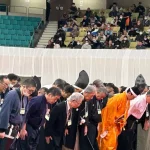
Kendo utilizes a “three-person-referee” system. Screenshot from YouTube KendoWorld channel. Fair use.
One reason why the Japanese martial art, Kendo, often described as “the way of the sword,” remains unregistered in the Olympic Games is due to the subjective judgment of its scoring.
Unlike many sports judged by clear numerical scores, kendo relies on the subjective determination of referees (shinpan/審判) on whether a strike meets the ideal of ki-ken-tai no icchi (気剣体の一致), which means the unity of spirit (ki/気), sword (ken/剣), and body (tai/体). A valid strike must combine correct timing, proper form, and strong intent, making kendo judging unique but inherently complex.
Kendo judgment frustration
However, concerns over fairness and consistency in judging have grown louder. As kendo expands globally, questions arise about how to balance tradition with demands for more objective, transparent scoring. The debate over introducing video replay and sensor technologies has sparked passionate discussions within the kendo community.
It is not usual to see Kendo players and audiences expressing frustration over the scoring after Kendo matches. Here is an example of such a complaint on X:
剣道は誤審が多いです。年上の審判が旗上げれば、他の人も上げます。強豪校のネームだけで、旗あがります。
Kendo has many controversial judges. If an older referee raises their flag, others follow. Sometimes, just the name of a top school sways the decision.
Kendo Mirai Kenkyujo, a Kendo online magazine, also addressed the controversy:
後からスローモーションなどで見て、部位に当たっていないのに一本となっている場合、それで剣道への“信頼感’’が揺らぐ。“剣道ってカッコいいね’’と言う人は多いのだが、何のゆかりもない人が剣道ファンになりにくい理由はそこにあると思う。
When you replay the video in slow-motion replay after the match and see a strike didn’t actually hit the target area but still counted as a point, it shakes trust in kendo. Many say, ‘Kendo looks cool,’ but I think this lack of trust is why outsiders rarely become fans.
However, as pointed out by a Kendo practitioner @kendo358 on X, some of the misjudgment claims result from a lack of understanding of Kendo’s martial art spirit and standard:
「当たっているのに1本にならない」 剣道の基本が出来ていると思っている時に現れる症状。 審判は理由を言ってくれない。 また、勝手に誤審だと決め付けない。 試合剣道に囚われて基本が抜け落ちていないか。 普段の基本稽古で誰が見ても瞬間的に旗を上げてしまうような打突が出来ているか確認。
‘The strike is hitting the target, but wasn’t counted as a valid strike.’ This often happens when you think you already have fundamental basics of kendo. The referees won’t tell you why, but don’t rush to label a call as a misjudgment. Reflect: Are your strikes so clear and decisive that anyone would raise their flag instantly? Maintain strong fundamentals in regular practice.
Hierarchical and subjective judgment
Nevertheless, the Kendo judgment system does have some flaws. The current “three-person-referee system” (sanshinsei/三審制) was introduced in modern Japan during the early Showa era (1929–1989) to reduce individual bias and improve scoring accuracy. A strike is only awarded if at least two referees agree that the strike satisfies ki-ken-tai no icchi. This includes correct timing, a vigorous kiai (shout/気合), proper footwork, and full commitment of body and mind. While the system is meant to balance perspectives and minimize biases, unlike sports such as fencing, which uses electronic devices to help mark a valid strike, Kendo’s score relies heavily on human interpretation of intangible qualities.
Moreover, the ranking of Kendo practitioners, which progresses through the 1–8 Dan system (段), has resulted in a hierarchy among all practitioners, including the referees. Hence, in theory, all three referees have equal authority, but in practice, assistant referees often defer to the chief referee in uncertain situations, thereby undermining the “three-person referees system”.
One 1929 debate between the famed kendo practitioner (kendoka), Sasaburou Takano (高野佐三郎 1862–1950) and Kendo history writer Kengo Tominaga (富永堅吾 1883–1960) after the imperial tenran budō matches (天覧武道大会) foretold how the seniority and hierarchy embedded in Kendo would undermine fairness in matches:
高野「あれは三人が一心同体でやらないといけないですね。表審判が手を挙げれば大概揃ふ様にありたいものです。」
Takano: The three referees must act as one unified mind and body. When the chief referee signals a decision, ideally, the other referees’ judgement align with it.
富永「一心同体なら主審はやりよいですが、三心三体の場合は大変なことになる、裏が表と意志が通じてゐない時は、審判しにくい場合が有るかも知れないですなあ。」
Tominaga: If they are truly united as one mind and body, it’s easier for the chief referee. But it can be quite difficult if it becomes ‘three minds and three bodies.’ When the chief referees and assistant referees are not on the same wavelength, it might become challenging to judge.
Technology versus tradition
In response, many advocate for modern technology — such as video replay or sensor-based scoring — similar to systems used in judo and taekwondo. Supporters argue this could provide objective evidence for reviewing close calls, helping referees, competitors, and spectators alike.
Opponents, however, warn that such changes would undermine kendo’s spiritual and educational essence. In budo (武道 or martial arts), misjudgments can be opportunities for humility, self-reflection, and growth — values seen as more important than the match result itself, as argued by Sadayuki Mimori, Renshi 7th Dan of The All Japan Kendo Federation (AJKF):
武道である剣道にとって、相手の部位を正確に打つことは表層的な目的。本来の目的は精神性の向上です。勝てたならば現状に甘んじることなくより高みを目指す向上心を持ち、負けたならば自分の弱点を認めて改善に努める潔さを養う。仮に誤審で負けたとしても、自分に落ち度はなかったのかと振り返り、進歩的にとらえてその後の糧とする。武道である剣道では、結果自体よりも結果から何を学びとり、その後にどう生かすかが重要なのだと私は考えます。
For kendo as budō, accurately striking the opponent’s target area is only a superficial goal. The true purpose is spiritual cultivation — striving for higher levels in victory, and improving oneself in defeat. Even a loss due to misjudgment should be reflected on and used for growth. What matters is not the result itself, but what you learn from it.
The debate echoes a familiar story. Judo (柔道) became an Olympic sport in 1964 and adopted clear judging standards, including video review. However, years of standardization and application of technology have not stopped debates over misjudgment, as shown in the Paris Olympics Judo controversy. Instead, some, such as X user @KatakuroK, argue that Judo has lost its martial art spirit in the process:
問題になってる誤審ピック柔道。あれは見てて本当に酷かった。 『柔道』じゃなくスポーツの『JUDO』になって明らかに武道の格が落ちてる。僕も多少なりとも経験あるから。 その点で剣道は『武道は勝ち負けだけじゃないから』とオリンピックに採用を拒否してるとかないとか。
The misjudgement of judo in Olympic was being the subject of controversy, and it really was terrible to watch. As a person who experienced some, I’d say It is not ‘judo’ in the budō sense, but ‘JUDO’ of sports, and the status of martial arts has clearly fallen. In that respect, kendo refuses to be adopted by the Olympics, saying, ‘Martial arts are not just about winning or losing.’
Many kendo practitioners fear that rigid rules or technology could push the martial arts toward Western-style sportification. Thus, before embracing technological solutions, many in the kendo community point out the need for strengthening fundamentals, namely public education and clarification of judging standards, and reforming the current judgment system to make it less dependent on ranking and seniority, etc.