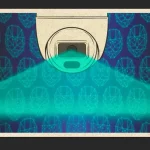
A medical report shows an undetectable viral load. Illustration by Minority Africa, used with permission.
This story was written by ID Christopher and originally published by Minority Africa on January 02, 2026. This edited version is republished as part of a content-sharing agreement.
I’m not sure what I thought his reaction would be, but I was relieved when Silas asked me to repeat what I said after I told him I was poz. He hadn’t heard me correctly, or he couldn’t believe what he had heard; I couldn’t tell which it was. So, with a smile and a wave of my hand, I told him not to worry, that what I said wasn’t even important. That was our second time together, and we would have sex one last time before I’d stop seeing him.
I still wonder what would’ve happened if I had clarified that statement. Would he have accused me of trying to infect him? Would he have told me to get out of the hotel room, to never text him again? At the time, I thought it wasn’t a matter of whether Silas was a person who could do that, but that I had sex with a man whose reaction to such disclosure could’ve been awful. It said more about my discernment and my process for sexual engagement than it said about his or anyone else’s awareness about HIV.
“Don’t tell him yet,” said my acquaintance Usman, who works in a healthcare facility in Enugu, when I told him I was considering disclosing my poz status to a love interest, David. I had met David in person only once after we anonymously matched on a dating/hookup thread for queer men on Twitter.
“I think he’ll take it well,” I said. “He’s a medical student. He’s brilliant.” Now I know that being a medical student does not equate to having basic knowledge of HIV/AIDS, neither does being brilliant equate to empathy or a degree of curiosity that is necessary for dating. I didn’t realise this when Usman told me to take my time, to wait until I was virally suppressed before telling David, whom I hoped to be romantically paired with. Eventually, my poz status became one of the reasons I doubted the possibility of romance with David. Not that he didn’t care or that it wasn’t obvious he cared, but not getting a response to a message in which I shared one of my fears about living with HIV showed that discernment is required in prioritising vulnerability.
It’s one thing to be open-minded and empathetic, but having the depth and time to make space for someone else’s truth is a rare ability. So, while I wish I had taken Usman’s advice on that particular disclosure, I don’t regret telling David. I hold no grudge about it; I had, after all, revealed my status to him without being asked. However, the reality check was clear enough to become another channel for my self-criticism.
After an intense school period early this year, I needed a breather and a new writing space. I asked Nolan, who lived in Enugu, if I could briefly move in with him, and he confirmed that it was doable. The renovation of his apartment would be completed in a month, so I waited three weeks and sent him a reminder. I called and texted more than twice, and he never responded. At first it was hard to think that he had been worried about living with a poz person. Then I thought he didn’t know how to say so without hurting me.
I was upset for a while, but I stopped speculating. I reminded myself that certain persons in my life, whom I had befriended online, had people and places beyond that connection. Surely, Nolan must’ve had more urgent or important issues to deal with. If he had avoided me because I was poz, because he feared that we would be sexually involved, it said nothing about me that should be a cause for self-disgust. But it reinforced an internalised stigma I thought I had overcome.
In February 2023, when my friend TK asked me how many people were aware of my status, I made a list in my head for the first time since the diagnosis. Two, three, five, not including the health officers. TK nodded and said, “That’s okay. Don’t tell any other person. You know, because of the stigma.”
I wanted to tell TK that I didn’t have to worry about being outed and mocked or stigmatised when there was nothing to be ashamed of, but I knew he meant well. In a way, he was right. The issue of disclosure was completely within my power. I could decide whom to tell, and only if it was absolutely necessary.
Olisa, a longtime partner of a friend of mine, had the same fear. “It’s a vicious world out there,” he said. I asked him if he really thought I could be outed and disgraced, my photographs posted on social media with captions heavily punctuated with “beware” and “danger” emojis. “What’s the worst that could happen?” I wondered out loud. He smiled after a brief silence and shared his own history with HIV.
At some point, Olisa touched my collarbones and said, “You’ll be fine. You shouldn’t even worry about weight gain. You’ll eventually have full shoulders.” I couldn’t help but blush. I even laughed when his story took a comic and relatable sexual turn. I felt seen and safe.
As a queer Nigerian, my sexual history intersects with religious and bodily trauma. For me, sex education and sexual health awareness had been ensured with the combined weight of severe repression and intense curiosity, alternating periods of dignified ignorance and obsessive indulgence. Certain presumptions seemed to be facts and remained unverified for a long time. I once thought it urgent to get tested for HIV after I accidentally digested someone else’s semen. I once had unprotected sex because I was convinced that there was a mutual intention not to cause any harm.
As I got older and saw the thread of credulousness in such actions, I realised how the anxious attachment style I developed in childhood extended to my need for connection. Now, before disclosing my poz status, I ask myself: Why tell this person? Of what significance is my HIV status to our relationship?
I think about my past disclosures and wonder if I feared rejection so badly that I thought it best to reveal my status to anyone I was romantically interested in. Was I compelled to believe that he who saw my wound and still chose to walk with me could be the one? Even now, with my undetectable poz status, I still think it best to inform a man who wants to be romantically paired with me, the reason being that I’m inclined to share my truth as may be necessary without fear of a drastic or eventual disconnection. Who else should be aware of my history with HIV if not the person I would be monogamously paired with?
It is due to the stigma that my parents and siblings remain unaware of my HIV history. It’s been three years since the diagnosis, one year since I reached undetectable. My parents’ reaction to my becoming irreligious showed me what would happen if I came out as gay or nonbinary, or if I revealed my poz status. Still, there are fond memories of the week we spent looking to treat an ear infection I had a few months before my HIV diagnosis. When I learned that the swollen lymph nodes had been a symptom of HIV and the direct cause of the infection, I felt lucky that no blood tests had been run at the hospital where I was treated. Sometimes I imagine my parents becoming aware and asking me: “Why didn’t you tell us? Where did you get it? Who gave it to you?”
There would be no better way to respond than to tell them how HIV has shaped my perception of love and desirability. My childhood with the periods of neglect and sexual abuse. My young adulthood with the need to justify my interest in provocative imagery and the study of nude art photography. It is all connected. The root of my life extends from ages ago to ages beyond my time. I channel my thoughts and growing awareness to the intersection of art and queerness. Through self-portraits, I hold hands with those who came before me: the artists, writers, and sages who were faced with the unfathomable urgency of making art despite the looming shadows of their deaths. As I tell this story, I become an ancestor. I reach out across a field of realities and wait patiently for future lives to find my words.
I often imagine being in a long-term relationship with a man and navigating this society together, but I doubt the possibility, given the complex issues and layered realities associated with homosexuality in Nigeria. It’s more likely that I will maintain a friendship with benefits or have long periods of abstinence in between random sexual activities. Whatever would be the case, I’m most certain my poz status will continue to determine my choices, and all for good.
I don’t imagine that I’d have any more tearful hours triggered by isolation or an overwhelming fear of my body’s failure to fight HIV. If my next viral load test shows a setback, I trust myself to get back on track and to be familiar with my body’s ability to surprise me. And if the tears should come with all that progress, I will let them run free because crying, too, is another way to ensure my wellbeing.