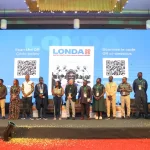
A number of Ryukyuans performed their traditional songs at the People’s Forum NYC on April 26, 2026. Screenshot from the event’s Livestream on the People’s Forum NTY’s YouTube channel.
This post is part of Global Voices’ August 2026 Spotlight series, “Indigenous Rights.” This series offers insight into the lives and experiences of Indigenous peoples to build connections across regions, center Indigenous experiences, and share the stories of leaders, activists, community members, and more. You can support this coverage by donating here.
During the meeting of the United Nations’ Expert Mechanism on the Rights of Indigenous Peoples (EMRIP) on July 13, several Ryūkyūan NGOs, experts, and advocates took to the floor, urging Japan to legally recognize their Indigenous status and resolve the longstanding issues caused by the U.S. military bases spread throughout the island of Okinawa, Japan.
It was not the first time this issue had arisen. Since 2008, various UN committees have issued six separate recommendations that the Japanese government recognize the Ryūkyūan people as an Indigenous group. Even so, the Japanese government has repeatedly refused to grant them Indigenous status.
Japan is, in general, considered an ethnically homogeneous country, yet two distinct groups, the Ainus and the Ryūkyūans, have ancestral, pre-colonial ties within the Japanese archipelago. The Ainu People, with their unique language and religious practices, are geographically tied to Hokkaido, while the Ryūkyūan People have been residing in the Ryūkyū archipelago for several thousand years according to their creation stories and were unified in the 15th century under the independent Ryūkyū Kingdom (1429–1872).
Since March 2001, UN bodies, in particular the UN Committee on the Elimination of Racial Discrimination (CERD), have issued recommendations that the Japanese government officially recognize the Ainus and the Ryūkyūans’ Indigenous status so as to protect their lands and cultures.
The Ainus’ Indigenous status was eventually recognized in 2008 and codified under the Ainu Policy Promotion Act in 2019, which empowers the Ainu to participate in the development of Hokkaido and provides funds for Ainu-centered tourism, commerce, and industry in the region. But the Japanese government has not granted them inherent Indigenous rights, including self-determination and rights to land and natural resources, in accordance with the United Nations Declaration on the Rights of Indigenous Peoples (UNDRIP).
However, the Ryūkyūan People’s quest for self-determination and Indigenous status has been thwarted by aggressive assimilation policies since the rise of the Japanese Empire beginning in the Meiji era (1868–1912), and further hindered by the heavy US military presence on the island.
More than a century of assimilation
Historically, the Ryūkyū Kingdom served as a trading bridge between China and Japan. It was considered a Chinese tributary state during the Ming dynasty, but was annexed by Japan in 1872 and weathered more than a century of forced assimilation policies. These policies included replacing traditional Ryūkyūan family names with Japanese surnames, banning local religious practices in favor of Japanese Shinto, teaching that the native culture was inferior in schools, suppressing the Ryūkyūan language by labeling it a “backward” dialect of standard Japanese, and more.
In 2009, UNESCO listed the Ryūkyūan language as endangered and warned that it would face extinction as early as 2050. Yet, there is no national policy to rescue the language given its “dialectic” status. An Okinawan linguistic scholar, Michinori Shimoji, discussed the Japanese language policy on his blog:
この琉球諸語がまさに今消滅の危機にあって、現在の琉球列島の人々(私を含む)は日本語への収束が進みつつあるが、それを指してヤマトの側が「あなたたちはもはや日本人で、あなたたちの話す言語はただの方言だ」というのは、放火犯が「あなたの家、燃えましたね」というに等しい。
These Ryūkyūan languages are currently in danger of extinction, and while the people of the Ryukyu Islands today (myself included) are increasingly assimilating into Japanese, to say, ‘You are now Japanese, and the language you speak is merely a dialect,’ is tantamount to an arsonist saying, ‘Your house burned down, didn’t it?’
For the most part, these assimilation policies have successfully curbed the Ryūkyūan Indigenous rights movement.
In 2024, prefectural councils in Okinawa passed resolutions officially demanding that the UN retract its recommendations for the Japanese government to grant Indigenous status to Ryūkyūan. A survey in 2022 indicated that while around 60 percent of residents in Okinawa agreed their identity is distinctive, 95 percent did not view themselves as Indigenous, mainly because 70 percent had little idea about Indigenous rights under the UN framework. Some were worried about sowing unnecessary domestic division, while others feared foreign influence from China might lead to the complete removal of U.S. military bases, which might adversely affect Japan’s national security.
This leaves Indigenous rights advocates in a difficult position, where they seemingly have to decide between self-determination through recognition and reduced regional security.
U.S. military presence in Okinawa
There are 31 active U.S. military installations throughout Okinawa today — bases which have further hindered Ryūkyūan claims for Indigenous rights.
During World War II, U.S. forces seized the Ryūkyūan islands, displaced hundreds of thousands of Ryūkyūans from their lands and homes, and built robust military infrastructure throughout the islands. Between 1945 and 1972, the U.S. took over the administration of the islands, as, geographically located in the Eastern part of the Pacific Ocean, they became a strategic spot for providing military support to the U.S. Army and Navy during the Korean War (1950–1953) and the Vietnam War (1955–1975).

The city of Naha in Okinawa. Outside the U.S. military bases, many Okinawans live in dense cities. Image from Wikimedia Commons. License CC BY-SA 3.0.
Although widespread protests in Okinawa forced the U.S. to return the island to Japan, under the U.S.-Japan Status of Forces Agreement (SOFA), U.S. military personnel still enjoy jurisdictional privileges and are often exempt from local prosecution even if they commit crimes against locals.
Within Japan, Okinawa hosts 70 percent of the U.S. military bases. Today, the U.S. Military uses between 15–18 percent of Okinawa’s land for its bases and facilities. Without official permission and security clearance, local Okinawans cannot access these bases.
On the ground, this translates to dense cities for the locals, while the U.S. military bases enjoy ample space, including single-family housing with American-style yards and sprawling lands throughout the base. The following screenshot offers a rough visual example of the density differences between one installation, the Kadena Air Base, and the surrounding city.

A satellite screenshot of the U.S.’s Kadena Air Force Base in Okinawa — one of the 31 U.S. military installations on the island. The base territory is roughly outlined in yellow to highlight the base density compared to the city outside of it. Fair use via Google Maps.
The majority of Okinawan residents oppose the expansion of military facilities, and the local government, including the current Governor Denny Tamaki, has frequently appealed to reduce Okinawa’s U.S. military base burden. However, the Japanese government often ignores the public appeals.
In addition to space issues, this heavy concentration of bases leaves residents with both health and security concerns. High levels of PFAS, including PFOA, chemical substances associated with cancers, have been detected around U.S. military bases in Okinawa, presumably coming from firefighting foams used in training, yet the U.S. base denied local access to investigate the pollution.
The same base presence driving health and sovereignty grievances is also why recognition remains politically challenging for Tokyo. Recognizing Ryūkyūans as an Indigenous group could give them legitimate land claims, which is somewhat complicated given that Japan has already effectively ceded much of Okinawa’s land to the U.S. military forces. Within Tokyo, these bases are seen as an essential military and political force that can help with ongoing tensions with China and North Korea — regardless of what it means for local residents in Okinawa.
Against such a backdrop, during the EMRIP, a representative from AIPR urged the UN expert mechanism to strengthen its advice to the Japanese government on the rights to access justice:
[The] state must not invoke jurisdictional fragmentation, military agreement, security arrangement, interagency transfer of responsibility, or their own failure or refusal to recognize Indigenous peoples status as grounds to deny, delay, or deflect access to effective remedies.
However, national security concerns have undermined Okinawan basic rights, and their fight for Indigenous status will be rougher than that of the Ainu in Hokkaido.