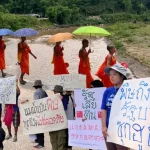
Students protest with a banner saying ‘Science and public university are people’s rights.’ Photo by Diario UNO, used with permission.
This article was written by activist Facundo Rodriguez as part of CADE’s Forus-led Youth Voices for Digital Rights programme, and is published here under a partnership agreement with Global Voices.
In a global context where our rights to protest face increasing pressure, the Argentine experience in youth manifestations, at a time of Generation Z protests worldwide, offers a reading lens into how contemporary youth participation is organised and can emerge from “civic space darkness.”
Argentina’s latest university protests began in 2024, the first year of Javier Milei’s government, and were sparked by austerity, inflation, and budget cuts to public higher education, which threatened the historic role of public universities as engines of social mobility. Over a year later, they are now merging with more recent mobilizations that reflect deeper generational concerns about gender justice, equal access to knowledge, social mobility, and the future of public institutions.
Unlike movements in earlier decades, Argentina’s youth-led protests are increasingly organized digitally through platforms like TikTok, Instagram, and WhatsApp rather than through unions or political parties. The Marcha Federal Universitaria in April 2024 — replicated in October — spread rapidly through hashtags such as #MarchaFederalUniversitaria (#FederalUniversityMarches), coordinated by student groups and open networks nationwide.
The defense of public education has become central. This movement is driven by a generation aware of how underfunding public universities directly affects their access to quality higher education.
In recent mass marches defending universities, the factor of “organicity” was once again evident. Mass participation was not solely due to student or union organizations (“organic”), but also to tens of thousands of independent students, non-activists, who felt individually called to join. The organization of these protests combined street action with numerous social media initiatives (TikTok videos, X threads, graphic content) to raise awareness of the issue.
On September 17, 2025, tens of thousands marched in Buenos Aires demanding restoration of funding for public universities and pediatric health as part of broader protests against austerity measures targeting education and health. Social media posts and calls mobilized using slogans such as “Nuestro futuro no se veta” (“Our future can’t be vetoed”), associated with the protest plan.

A protester holds a sign saying ‘University for the people,’ in Entre Ríos, Argentina. Photo by UNER’s Social Work Faculty/Institutional Communication Department, used with permission.
Recent data from the EU SEE initiative points to a trend in which new generations mobilize through hybrid models where traditional and digital participation mechanisms coexist with decentralized, horizontal, and explosive forms of civic action.
At the same time, pressure on civic space, civil society organizations, polarization, and disinformation campaigns shape and mold participation. But no form of civic participation is static, and across the region we are seeing new modes of protest emerge: intergenerational coalitions, digitally mediated campaigns, and youth-led actions that combine online mobilization with street-level presence.
Generation Z, those born from the late 1990s to the early 2010s, now represents roughly one-quarter of Latin America’s population, or about 160 million young people — one out of every four Latin Americans. As digital natives, they have developed new forms of parasocial engagement online, sharing key concerns: the climate crisis, social, gender, and economic injustices, and heightened economic pressures.
Youth protests in Argentina, particularly those of GenZ, operate under this model of action — a dual path where the streets and social media do not compete, but rather reinforce and amplify one another. While these movements inherit tactics from traditional activism, they reinterpret them with their own logic.
Unlike mobilizations led by traditional actors, such as trade unions or political parties, which follow an inorganic, hierarchical, and planned structure, youth participation is often much less structured, more individual, and sparked by specific events that generate mass engagement. Still, these young actors also collaborate with traditional structures, which provide political and organizational support to the movements.

‘We made it. It’s a law!’ In 2020, Argentina approved a law to permit the interruption of pregnancy. Photo by Iro Bosero on Wikimedia Commons (CC BY-SA 4.0).
The ‘Green Tide’
The campaign for legal, safe and free abortion, under the movement of the Marea Verde (Green tide), around 2015 and 2020, is highly illustrative of this dynamic. Although there was central coordination through a national campaign, what ensured its success and mass appeal was a social dynamic that became autonomous and organic.
The Ni Una Menos (Not One Woman Less) movement in particular united millions to confront sexist, machista violence, since 2015. A tweet was turned into a slogan and a viral hashtag, spreading across social media and transforming into a mass movement. Gen Z and millennial activists not only amplified the message online, but also drove huge mobilizations offline. For many young Argentines, the movement was a defining entry point into feminism, inspiring their participation not only in anti-femicide marches but also in related campaigns such as the successful fight for reproductive rights. The movement became a phenomenon of cultural identity.
This wave operated simultaneously on two fronts. On the streets, through mass protests, “pañuelazos” (green scarf demonstrations), and vigils that displayed physical strength and territorial presence. And on social media, the green scarf became a symbol and a continual generator of content, educating, pressuring representatives, and shaping the media agenda.
The same digitally driven dynamic has shaped other intergenerational and intersectional protests. In October 2025, thousands gathered in Buenos Aires demanding justice for three young women whose torture and murders had been broadcast online. In both cases, Argentina’s young people are using the tools of their generation to transform online outrage into real-world collective action, rooted in connectivity and rapid mobilization.
The political context is decisive. The period 2015–2021 marked the height of the feminist struggle, which succeeded in generating public debate and securing reproductive rights, fighting against gender-based violence, and femicides at the centre of the national agenda. The current political period in Argentina has sought to curtail some of these discussions.
Meanwhile, the legacy of the Mothers and Grandmothers of Plaza de Mayo is still shaping today’s movements in the country. In the midst of the latest dictatorship (1976–1983), these women took to the streets to demand the safe return of their disappeared sons, daughters, and grandchildren — a cause that continues to this day.
Milei’s government, however, has attempted to roll back aspects of the feminist agenda, reducing institutional support for gender policies, defunding programs, and questioning the legitimacy of feminist demands.
This has led to many other movements linked to economic, social, and environmental equality, and to a renewed urgency of state responsibility. Feminist movements are also active and seeking to regain momentum in this context.
The contextual shift

‘Sorry for the trouble, I’m standing up for my rights’: students’ protest in Entre Rios. Photo by UNER’s Social Work Faculty/Institutional Communication Department, used with permission.
This logic of civic mobilization, though with its own characteristics, has precedents in other provinces and contexts. In Entre Ríos, protests to protect wetlands and rivers are a central feature of the public agenda, shaped particularly by the region’s geography, with its many freshwater channels and wetlands.
Although not as large-scale or youth-led as the Green Wave, these movements share traits of self-convocation. They also build on a key historical precedent in the province: the massive resistance of the citizens of Gualeguaychú against the installation of the UPM-Kymmene Oyj (UMP) pulp mill (formerly Botnia), which demonstrated civil society’s capacity to organize sustainably outside traditional structures.
The greatest challenge of this hybrid model is the risk of purely symbolic or performative activism: the illusion that digital activism (posting a story, signing an online petition) is sufficient in itself, replacing collective action on the ground.
Youth movements themselves show that the public and physical street remain central and irreplaceable. The LGBTQ+ Pride March, which mobilizes hundreds of thousands of people across Argentine provinces every November since 1992, in memory of the founding of Nuestro Mundo, the first LGBTQ+ organization in Latin America in 1967, is proof of this. While it could exist as a digital event, the physical gathering, the celebration of bodies in public space, and the demonstration of numbers remain irreplaceable political acts.
The future of GenZ mobilizations in Argentina does not appear to be purely digital or purely analog. It is this dual path: social networks to organize, raise awareness, and build identity; the streets to exert pressure, make collective strength visible, and materialize change.

Disclaimer: This publication was co-funded by the European Union. Its contents are the sole responsibility of Facundo Rodriguez and Forus, and do not necessarily reflect the views of the European Union