The security we don’t see: A call for solidarity, not sympathy · Global Voices

Graffiti in the subway, underground in Vienna’s Favoriten district: ‘Solidarity not charity’ and ‘EU disarm!’ Photo by Herzi Pinki on Wikimedia Commons (CC BY-SA 4.0).

Graffiti in the subway, underground in Vienna, Austria’s Favoriten district: ‘Solidarity not charity’ and ‘EU disarm!’ Photo by Herzi Pinki on Wikimedia Commons (CC BY-SA 4.0).

Author’s note: I write this piece from a place of proximity. My brother served as an ER doctor in rural, border-adjacent areas of Turkey, giving me (with consent) access to frontline realities and perspectives. I’ve seen how a missed meal can become a missed school day, which can lead to a tense night shift for someone at the ER. Through my brother’s work and my studies in international relations and politics, I’ve spoken with teachers, municipal officers, shopkeepers, and families caught between broken systems and survival. I don’t offer easy answers; I offer observed connections between food security, healthcare, education, and policy. This is a call for solidarity across borders and time, because what happens in Van or along Turkey’s margins reflects struggles everywhere. Understanding how systems fail or succeed in one place teaches us how to show up for one another in all places.

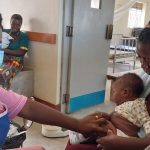
A baby’s fragile body leans against her mother’s shoulder, lips parched and cracked like the dry earth. The watered-down bottle in the bag is a desperate attempt to turn poverty into survival. The infant’s faint cry cuts deeper than any scream. With each new disaster, the growling stomachs, the paychecks sacrificed, and the buses that never arrive, the crisis escalates with brutal intensity. By the time they reach the triage desk, exhausted and depleted, they’re no longer just statistics; they’re real people bleeding into our weekend, into our lives.

Elsewhere is an illusion. We’re fooled into thinking humanitarian issues are confined to a separate world called “overseas,” and safety belongs to a different world called “home.” But the truth is, these two worlds bleed into each other. I’m not suggesting that we should only care about aid because it keeps us safe. I’m saying we need to face the reality that our world is connected. When people’s basic needs are met before crises erupt, our communities stay peaceful, not because we police more, but because fewer people are pushed into making desperate choices.

How do shocks travel? Here are three ways: First, supply chains. Drought, blockade, or harvest failure in one region shows up as price spikes in another. A bread line there becomes a grocery bill here. Second, they spread quickly through timelines and algorithms. Outrage travels faster than context. Disinformation finds people who are already tired, anxious, and angry, whether in Gaziantep or Glasgow. Third, routes of human movement. When safe, legal paths are choked off, people don’t stop moving; they move in more dangerous ways, empowering smugglers and organized crime. 

None of this is abstract if you are a teacher, a nurse, or a shopkeeper. It shows up in attendance, waiting rooms, and receipts. Investing in basic needs upfront brings a safety dividend, not surveillance. By providing school meals, we get kids back in classrooms, not on the streets. Cash support stabilizes monthly expenses, shutting out loan sharks. When municipalities work together across borders, both neighborhoods brave the cold with fewer crises. This isn’t preaching on generosity; it’s a clear-eyed look at how the system works.

So, what actually helps? Knowing that this issue exists entitles us to take action. By spreading awareness and holding leaders accountable, we can shape policy and create meaningful change. It’s not about grand gestures but rather small, collective actions: a social media post, a brief message to a representative, or a small donation to support a worthy cause. Most importantly, we must remember that the individuals affected are human beings, not just numbers. Only when they are safe can we truly experience harmony. This may not fit a catchy slogan, but it’s a doable, actual goal.

Today, with AI and surveillance on the rise, national borders gaining importance, and leaders emerging who only consider themselves, we must think of one another. We can’t afford to give away our solidarity, not even for a second. This is the time when we’re more connected than ever with people across the oceans. We have to stand together, or one day, we’ll face crises we never thought possible in our lifetime. Our dignity, humanity, values, and families are all at stake. We must shout for people’s rights globally. We are one, and we just need to remember that.

I head back to the ER, where two drowsy brothers wait. The room smells of damp ash from the stove they moved inside when the cold snap hit, and their bill skyrocketed. Oxygen revives them, clearing the haze from their eyes. A safer heater and winter assistance could have kept them safe and warm at home. When we ignore the struggles of others, preventable problems turn into costly emergencies. It’s not about panicking or feeling sorry; it’s about staying alert and spotting the connections between a late-night tweet in London, a bread line in northern Syria, and a packed triage room in eastern Turkey — connections rooted in supply chains, timelines, and policies that we can actually change.

We need clarity, not charity or fear. Solidarity, not sympathy. So, when spring arrives next year, more of us can walk the streets with serenity.



More Recommendations

Why Venezuela’s earthquakes were so devastating: Geology, vulnerability, and years of structural neglect · Global Voices - Map of the earthquakes’ impact across seven Venezuelan states, highlighting Ground Zero: La Guaira. Screenshot taken from the YouTube video […]
Nepali Poet Viplob Pratik on literature, language, and a life shaped by words · Global Voices - Poet Voplob Pratik. Photo: Prabhat R Jha. Used with permission. Viplob Pratik is a leading contemporary Nepali poet, novelist, lyricist, […]
Viral app ‘Are You Dead Yet?’ unveils the anxiety and pain of single Chinese youths · Global Voices - Screen capture from Chrome App Store. Fair Use. A newly developed Chinese App “Are You Dead Yet?” (死了麼?), designed for […]
Support Global Voices as we launch our donation campaign · Global Voices - Members of the Global Voices community at the GV summit in Kathmandu, Nepal, in December 2024. Photo by Jer Clarke. […]
Pitching power: Unpacking the T20 Cricket World Cup crisis between Bangladesh and India · Global Voices - Supporters at the India vs Bangladesh CWC15 quarter final at the MCG, Australia. Image via Flickr by Tourism Victoria. CC […]
How changing diets are creating new markets for Africa’s Indigenous crops · Global Voices - Packaged Cassava and Potato flour. Photo by Bonface Orucho. Used with permission. This story was written by Bonface Orucho and […]
Kenya’s smallholder farmers are challenging a law preventing them from sharing indigenous seeds · Global Voices - Illustration by Minority Africa, used with permission. This story by Jackson Okata was originally published by Minority Africa and a shorter […]
Reporting when the internet goes dark: How journalists find workarounds when cut off · Global Voices - Image from iMEdD, used with permission. This article by Elli Kostika, Katerina Voutsina, and Kelly Kiki is an excerpt from […]
How AI is upgrading African dictatorship · Global Voices - Illustration showing a dictator using surveillance and automated control to watch, predict, and suppress citizens. Illustration by Khalid Bencherif. Used […]
Caribbean athletes shine at the 2025 World Athletics Championships · Global Voices - Feature image via Canva Pro. Much of the world has its attention focused on the 2025 World Athletics Championships, which […]
MediaHack: 36 hours against electoral disinformation in Ecuador · Global Voices - Participants of the Hackathon in Quito, February 22 and 23, 2025. Credits: Ruben Zavala (Openlab). Photo used with permission. A […]
Reimagining Caribbean indenture in an artistically botanical afterlife · Global Voices - Image of the title wall of the art exhibition ‘The Botanical Afterlife of Indenture: Imaginative Archives,’ which took place at […]
Togolese expert Kofi Sika Latzoo explains the video game industry’s impact on the African economy · Global Voices - Senegalese journalists participate in virtual reality training at the 2016 Gamecamp Summer in Dakar; photo by Kofi Sika Latzoo, used […]
How far-right ‘fear tactics’ affect girls seeking legal abortion in Brazil · Global Voices - Illustration by Noor, used with permission In a video posted by Chris Tonietto in early November 2025 on Instagram, the […]
‘Silence has become both more dangerous and more complicit’: An interview with Lebanese-British artist, Amale Khlat · Global Voices - Amale Khlat, ‘Fishing on a Tridacna’ Cosmetic Vessel, 2023. 34 x 49 cm (13.4 × 19.3 in). Watercolor and archival […]
Why gender diversity matters in technology · Global Voices - The intersection of transgender rights and technology. Image courtesy of Global Voices. This editorial was written by Sheena Magenya and […]
In Barra do Turvo, Brazil, women promote biodiversity and harvest healthy food at fair prices · Global Voices - Women farmers in Brazil. Photo by João Ambrósio/O Joio e O Trigo, used with permission. This article was published on […]
What changes will arise from the Brazilian Supreme Court’s ruling on personal marijuana use · Global Voices - Image: Art by Global Voices. Free Use. Kindle Media/Pexels In a historic decision in June 2024, Brazil’s Supreme Court (STF), […]
‘Indigenous languages and cultures are surviving, and will continue to survive’: Interview with Juang-language writer Kshetrabasi Juanga · Global Voices - Kshetrabasi Juang being interviewed by Opino Gomango in Mysore, India. Image by the author. This post is part of Global […]
Climate change brings changes to North Kivu’s agricultural practices in the DRC · Global Voices - A maize variety exhibition. Photo by Hervé Mukulu from GreenAfia, used with permission This article by Hervé Mukulu was first […]
The key to saving potato cultivation amid climate disruption in the Democratic Republic of the Congo · Global Voices - CAPSA Luotu seed potato repository. Image by GreenAfia GreenAfia first published this article on September 10, 2025. Global Voices republished […]
Poisoned waters: Indigenous communities fight to protect Thailand’s Kok River · Global Voices - Communities demand action as Kok River contamination remains unresolved. Photo from Prachatai, content partner of Global Voices. This edited article […]
Who is talking about artificial intelligence in Ecuador? · Global Voices - From left to right: Mónica Reinoso (Defensoría del Pueblo), Susana Cadena (Datalat), Carlos E. Flores (Openlab), Marco Insuasti (Mintel) and […]
Woman journalist in Pakistan takes action against online harassment · Global Voices - Photo by Serje Lahoud from Pexels. Used under a Pexels Licence. A war that began between the United States and […]
Green dignity and public visibility: GIA’s intersectional approach to transgender rights and climate justice in Pakistan · Global Voices - An FGD session at the GIA premises. Image from the Facebook page of Gender Interactive Alliance. Used with permission. This […]
Some Caribbean podcasts to tune into on International Podcast Day · Global Voices - Feature image designed using Canva Pro elements. Monday, September 30 is International Podcast Day. As of June 2024, there are […]
Nepali music for an Everest-sized challenge · Global Voices - A screenshot from Resham रेशम – Prakash Dutraj, one of the songs in the GV Nepali playlist. Screenshot via YouTube. […]
Jamaican bobsledders bring unexpected joy to an island beset with post-hurricane stress · Global Voices - Photo of a display about the Jamaican bobsled team at the Jamaican Bobsled Café in Montego Bay by David Drissel […]
Cricket’s greatest all-rounder, Barbados’ Sir Garfield Sobers, dies at 89 · Global Voices - Statue of Sir Garfield Sobers at Barbados’ Kensington Oval. Photo by Winton Edghill on Wikimedia Commons (CC BY-SA 3.0). An […]
Tuvalu aims to become a ‘Digital Nation’ amid rising sea levels · Global Voices - An aerial view of Tuvalu’s coastal adaptation project. Photo from the UNDP Climate Flickr page. CC BY-NC 2.0 This post […]
Scroll to Top