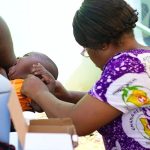
A nurse at Bukakata Health Centre III in the southern Uganda district of Masaka is administering an oral vaccine to a baby. Photo by WHO-Uganda country office, used with permission.
By Ronald Musoke
The African Union (AU) is launching one of its most ambitious health security missions yet: Ensuring that the continent manufactures 60 percent of its own vaccines by 2040. Africa currently manufactures a lowly 1 percent of vaccines. However, since April 2021, when the AU tasked the Africa Centres for Disease Control and Prevention (Africa CDC) to initiate a structure, technocrats have been busy pushing the dream. In the first of a four-part series, The Independent’s Ronald Musoke unpacks the continent’s plan, looking at both opportunities and hurdles.
From its headquarters in the Ethiopian capital, Addis Ababa, the Africa CDC is working to transform Africa’s vaccine landscape alongside international partners such as the European Union (EU), Global Alliance for Vaccines and Immunization (GAVI), and international financial institutions, such as the African Development Bank and the World Bank.
A major achievement, so far, has been setting up the Partnership for Africa Vaccine Manufacturing (PAVM) to develop the “framework for action” of the mission. That was in 2022. Another milestone was in February 2024, when PAVM was renamed the “Platform for Harmonised African Health Products Manufacturing (PHAHM) to reflect its expanded mandate that now includes developing “medical countermeasures.”
While the African Union (AU) has 15 years to hit its target of manufacturing 60 percent of its own vaccines by 2040, the Africa CDC Director-General, Dr. Jean Kaseya, is leading the mission with a sense of urgency. He says:
We saw during COVID-19 that all other countries can lock their doors and we (Africa) are left on our own; we saw with COVID-19 that African people could never survive if they did not get what others were calling appropriate vaccines. Who can accept that?
In late November 2023, on the opening day of the International Conference on Public Health in the Zambian capital, Lusaka, the Congolese-born expert in epidemiology and community health told journalists:
“I repeat, local vaccine manufacturing is the second independence of Africa,” adding, “Our countries got independence in 1960. But we saw with COVID-19 that Africa is not independent.”
AU vaccine agenda
Dr. Abebe Genetu Bayih, the Acting Lead of PHAHM, says the AU wants governments, manufacturers, national regulatory authorities, donors, and funders to work in a coordinated, concerted, multi-year effort in order to overcome constraints along the path to vaccine independence.
He says the venture is struggling to secure funding from traditional financing institutions because “vaccine manufacturing is a high-risk endeavour.” He also mentions the need for a robust regulatory framework to ensure that African manufacturers adhere to quality, safety, and effectiveness standards of vaccines.
Already, the Africa CDC and partners have concluded a study on the current vaccine manufacturing, supply, and demand landscape in Africa, with findings suggesting that the continent has 25 active vaccine manufacturing projects at three different stages of development.
Dr. Bayih told The Independent that five of these have commercial-scale manufacturing facilities with technology transfers signed or underway; five have commercial-scale manufacturing facilities but have yet to sign technology transfers, and 15 manufacturers are still in the early stages of development.
According to the African Manufacturing Landscape survey, currently, there are 574 health products manufacturers active in Africa. Among the existing vaccine players, about 40 percent engage in just packaging and labelling, and 40 percent engage in “fill-and-finish,” while five local companies engage in some degree of drug substance manufacturing, but mostly at a very small scale, with limited ongoing research and development (R&D) activity in the facilities.
This, experts say, is mainly due to a lack of local scientific capacity, along with weaknesses in the commodity supply chain, prohibitive regulatory regimes, powerful trade blocs, scarcity of potential buyers of vaccines, competition with subsidized markets, political instability, geographical and logistical challenges, lack of sustainable financing mechanisms and low economic purchasing power on the continent.
According to the Africa CDC, in the next five years, three African vaccine manufacturers are expected to produce and secure “World Health Organisation (WHO) prequalification” for nine different vaccines and supply the continental market. A few additional manufacturers will also produce vaccines at scale to supply their respective countries.
Support Global Voices as we publish more articles like this one
For more information about this campaign, please go here.
The case for local vaccine production
There is a significant demand for African-manufactured vaccines and medicines. The continent’s population makes up around 16 percent of the world’s population and suffers 25 percent of the global disease burden, with over 50 percent of the world’s infectious diseases.
Yet, despite having the highest global incidence of mortality caused by infectious diseases, just under 1 percent of the vaccines required by Africans are produced in Africa. Meaning, Africa imports 99 percent of its vaccines, with seven of every 10 vaccines used in Africa currently being donated through GAVI. This, experts say, has created a significant health security risk on the continent. Africa’s ever-growing population is expected to shoot from the current 1.4 billion people to 2 billion by 2040. This will ensure a threefold increase in vaccine demand.
Read more: The quest to localize vaccine manufacturing in Africa
According to Natasha Kofoworola Quist, a communications specialist at VaxSen, the commercial subsidiary of Senegal’s Institut Pasteur de Dakar, the demand for vaccines is set to more than double in volume from 1 billion doses today to over 2.7 billion doses in the next 15 years.
By producing vaccines locally, Africa will ensure that its people have timely and equitable access to critical vaccines, reducing reliance on external suppliers and mitigating supply chain vulnerabilities. Dr. Bayih also told The Independent that investing in a local vaccine manufacturing industry in Africa will result in significant long-term benefits, including increased sovereign health security, harmonization of regional regulatory and trade policy, a boost in technological expertise, higher GDP, higher employment, and savings from substituted imports.
The African Union has already prioritized vaccine manufacturing for up to 22 diseases, including the “legacy diseases” (Diphtheria, Whooping Cough, Tetanus, Hepatitis B, Yellow Fever, Tuberculosis, Measles, Typhoid Fever, Cholera, Meningitis). In the near future, the AU intends to expand production of HPV (Human Papillomavirus), HIV, Pneumococcal, COVID-19, and Rotavirus vaccines. It is also keeping an eye on vaccines for Ebola, Chikungunya, Rift Valley Fever, Influenza, and Lassa Fever, among others.
International and local support
In a bid to support Africa’s domestic vaccine manufacturing, several international partners, including development financing institutions like the World Bank, the Africa Development Bank (AfDB), the European Investment Bank, and the AfreximBank, have pledged billions of dollars worth of investment in Africa’s vaccine manufacturing and supply value chain. GAVI, one of the main buyers of vaccines that are administered on the continent, has, in principle, also pledged to support the continent’s vaccine programme.
With such assurances, over the last three years, billions of dollars’ worth of investments aimed at creating 23 vaccine manufacturing plants on the continent have been proposed. On June 20, 2024, the European Union launched a USD 1.1 billion project to accelerate vaccine production in Africa.
The EU said the program would offset start-up costs and ensure demand for vaccines in Africa.
All this is being done in close collaboration with African partners at national, regional, and continental levels (Africa CDC and AUDA-NEPAD), says Javier Niño Pérez, the European Union Ambassador to the African Union.
Challenges to tackle
However, Jane Nalunga, the Executive Director of the Southern and Eastern Africa Trade Information and Negotiations Institute (SEATINI-Uganda), a Kampala-based think tank, sees a number of issues that Africa must confront head-on to achieve vaccine independence. One, is the issue of intellectual property, particularly patents, she says. “Patents are controlled by private companies, and they are not into charity; patents are about money and making more money.”
Dr. Bayih agreed, adding:
African vaccine manufacturing requires an optimum technology transfer scheme that benefits both the innovator and the tech recipients. Moreover, African manufacturers should invest in making themselves tech transfer ready.
Dr. Adrian Ddungu Kivumbi, the Secretary General of the Uganda Pharmaceutical Manufacturers Association (UPMA), also told The Independent that “the 15-year timeline to the 2040 target is too long.”
According to him, the agenda that the African Union has established can be achieved, but he foresees limitations in funding, regulatory framework, and a lack of political will.
I will not even say that we lack manpower because we have highly skilled scientists that end up going elsewhere because we don’t pay them as much. If the salaries or the environment of work is conducive, we can have many people (retained) here (Africa). So we need to clean our own house.
And perhaps, more importantly, sustainable manufacturing of vaccines at scale must offer a predictable demand and offtake guarantee. Member states of the AU will have to commit to buying African-made vaccines. In order to avoid duplication, a potential waste of resources, and fragmentation of the market, there also needs to be a continental coordination mechanism.
Dr. Bayih says the success of African-made vaccines will be based on the ability to leverage the AfCFTA free movement of goods and harmonization of trade policies across Africa.