Scene from ‘El Eternauta’ (TV Series, 2025). Photo: Netflix, used with permission.
This article, written by the International Institute of Human Rights and Social Responsibility (IIRESODH) in partnership with the creative advertising and communication agency, Marcas, is published on Global Voices as part of a mutual cooperation agreement.
Our research used a social listening methodology to determine and analyze the combined impact of AI (artificial intelligence), entertainment, and effective narrative strategies on influencing more relatable, collective messages to reach new audiences in a crowded, overstimulating digital realm. We used the Netflix series “El Eternauta” (The Eternaut, 2025) and Argentina’s current socio-political landscape as an example.
The “El Eternauta” TV series is an adaptation of the classic Argentine sci-fi comic, written by Héctor Germán Oesterheld and illustrated by Francisco Solano López in the late 1950s after the 1955 military coup.
Beginning with a lethal, toxic snowfall, the storyline follows an alien invasion of Buenos Aires, introducing the notion of the “collective hero,” an idea that group solidarity is the only possible salvation from oppression. During Argentina’s last military dictatorship (1976–1983), this sci-fi allegory became a tragic reality when Osterheld, a political activist, along with his four daughters and sons-in-law, was forcibly disappeared by the regime.
This blend of fiction and reality transformed “El Eternauta” and, especially, its protagonist, Juan Salvo, into a symbol of resistance amid Argentina’s current political landscape.
The administration of right-wing libertarian President Javier Milei, who took office in December 2023, has made its fiscal balance policy a top priority. It has subsequently implemented the so-called “largest fiscal adjustment in human history” while waging a “cultural battle” to instill libertarian principles. In addition to other reforms, this involves real-term budget cuts in education, health, science, and elderly social security, as well as the innovative use of digital technology. In June 2024, Milei’s administration moved to implement a digital reform, which would see AI tools and systems heavily deployed in the public sector.

The character Juan Salvo, played by Ricardo Darín in ‘The Eternaut,’ 2025 series. Photo: Netflix, used with permission.
The public didn’t consider the global streaming platform’s release of this series as mere entertainment, but rather, a social affair steeped in memory amid public mobilizations against the new Argentine government’s reforms. This is why we chose this series as the focus of our analysis.
We would therefore like to share a few insights that may be useful to other civil society organizations (CSOs).
Entertainment as a channel for human rights
In a world saturated with information, individualistic and hateful rhetoric often garners the most attention on various platforms. Our research also suggests that the entertainment world isn’t a superficial space detached from reality, but a place that shapes common sense today.
“El Eternauta” was one of the 10 most viewed series on Netflix worldwide, touching a raw nerve in Argentine society at the time. Its alien invasion and collective resistance storyline initially kindled a sense of patriotic pride (“something of ours” shared globally) but soon became a realm of social movements.
For CSOs, the lesson is clear: younger generations engage with culture across multiple platforms. We, therefore, cannot rely solely on technical and legal terms. Instead, AI is a useful and accessible tool to adapt our messages, using humor and contemporary aesthetics, with products that once would have required greater investment and expert recruitment. This allows us to disseminate our causes more effectively as a subplot within cultural discourse, leveraging algorithms to amplify them.
From the screen to the street
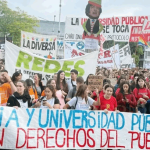
Through Juan’s iconic mask — a handcrafted diving mask with an improvised air filter, vital in preventing his inhalation of toxic snowflakes — the series’ symbolism transcends the screen. Blending with Argentinian humor and sarcasm, it carries over into real-world protests against the social security, science, and education cuts implemented by the Milei administration since 2024.
Throughout the country in 2025, people wearing masks or holding placards displaying messages from the series were a common sight at protests in support of science.
📣 Esto NO es ciencia ficción. Una tormenta destructiva avanza sobre el mundo del conocimiento.
Quienes no nos resignamos, nos organizamos. La resistencia está en marcha.📍 Miércoles 28/05 a las 13 hs. en el Polo Científico#NoAlCientificidio #CienciaEnMarcha #NadieSeSalvaSolo pic.twitter.com/05uwT60533
— RAICYT (@RAICYT_Ar) May 26, 2025
This is NOT science fiction. A destructive storm is sweeping across the world of knowledge. Those of us who won’t give up easily are rallying. Resistance has begun. Wednesday, 28/05 at 1 p.m. in the Science Center. (#StopScienticide) (#ScienceInProgress) (#NoOneSurvivesAlone)
Contra el #cientificidio. Defendamos la ciencia y la soberania argentinas.
SUMATE a las actividades que se hagan en tu ciudad y seamos muchxs.
En Bariloche nos juntamos el 26/5 a las 15:30hs en el CCT Patagonia Norte para organizar la movida del 28/5, sumate! pic.twitter.com/zgZT2S2wdG
— Adriana Cristina Serquis (@aserquis) May 23, 2025
Fight against #cientificidio. (Scienticide).
Let’s defend Argentinian science and sovereignty.
JOIN the events taking place in your city. We hope many of you will join us.
We’re meeting at the CCT Patagonia Norte (Scientific and Technological Center) in Bariloche on May 26 at 3:30 p.m. to organize the May 28 events. Join us!
Activists and citizens alike protested with placards and creative costumes made from winter clothing, hardware, and construction materials. They also used AI tools to create high-quality graphics for banners and social media rallying, enabling them to make the series’ aesthetics their own.
In doing so, they denounced the fact that, even today, just like in “El Eternauta,” they face their very own “toxic snow” and “cascarudos” (a sort of giant alien beetles) that “no one can survive alone,” and must be defeated collectively.
Although these items were spontaneous and not part of the CSOs’ campaign strategy, they did resonate.
Excelente escena de “El Eternauta” donde los hijos de puta de los cascarudos reprimen jubilados pic.twitter.com/ehadhi8rd6
— lajuliaeva (@lajuliaeva) May 22, 2025
A prime scene from “El Eternauta” where the goddamn beetles repress pensioners.
We highlight these points because they enabled social movements with limited budgets to keep pace with major studio productions in terms of media coverage and their positioning in the digital conversation.
This is where the “human perspective” of AI becomes tangible. We saw how technology helped images transcend the digital realm into “public squares,” proving that, despite its limitations, AI can be used as a catalyst for mobilization, not just virtual isolation. Calls for protests in defense of education and even the media would be “taught” to replicate their image.
Although some of the AI uses noted weren’t specifically intended for social protests and human rights protection, they highlighted that AI could have been put to better use. However, we must also recognize that this spontaneous, implicit use helped maintain the conversation sparked by this series, reinforcing the subplot’s (positive) messages outlined above.
Surviving the algorithm: The ‘subplot’ strategy
Our research suggests that, in the age of AI-curated feeds, social causes risk being buried by the algorithmic disinterest in politics.
However, we found these causes resonate more strongly when presented as human stories, leaving clues for viewers to investigate on their own. “El Eternauta” is not a tract, but its core message — “the true hero is a collective hero”— is profoundly political.

‘No one can survive alone’ is the motto for ‘El Eternauta’ Photo: Netflix, used with permission.
By exploring the subtle clues in the show’s subplot and its author’s story, individuals and organizations could direct the conversation toward memory, justice, and the common good, thereby confirming the feasibility of breaking through the information bubble.
The CSO strategy should be creative. This includes using AI to disguise the cross-cutting topics that algorithms actually distribute (film, art, and technology), transmitting the social message organically and effectively.
Deciphering the gaps and laying the groundwork
As a CSO, we must decipher the “gaps in the algorithm” and what’s happening around us. We must invest resources in understanding how these tools work, not to become digital experts, but to ensure the message of solidarity doesn’t get lost in all the hype.
A final consideration that goes beyond technology. If we can entice a young person to look up from their phone and join a collective cause, the world that greets them must offer the sense of belonging and support that algorithms seem to provide.
Mastering AI to deliver our agendas creatively isn’t our only mission. Our other mission is to lay the groundwork for when new audiences decide to break away from the “Big Tech” dynamic to find a more community-based space with initiatives that challenge and engage them.