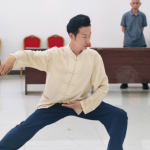
Maestro Porfirio spars with a student, practicing defensive techniques. Photo by Rowan Glass, used with permission.
This story by Rowan Glass was originally published on April 3, 2025 in Lazo Magazine. An edited version is republished on Global Voices with their permission.
In the Afro-descendant town of Puerto Tejada, in the southern Colombian department of Cauca, a handful of master swordsmen represent one of the last bastions of the traditional martial art called “grima,” or machete fencing. From its origins in the colonial era to the threats facing this ancestral art form in the present, grima is an integral part of Afro-Colombian cultural heritage.
The House of Cacao
The House of Cacao offers a cool and tranquil refuge from the tropical sun in a region known for its sweltering heat. Yet, even in this cultural center, a welcome shelter from the clamorous streets outside, the metallic ring of steel striking steel breaks the quiet repose. Here, in the Academia de Esgrima de Machete y Bordón, some of the last masters of an ancestral Afro-Colombian martial art propagate their teachings to younger generations dedicated to the survival of their heritage.
“This is an art that, ever since our African ancestors arrived in this country, we have maintained and preserved through the generations,” explains Maestro Miguellourido, a recognized master with fifty years of experience in the art. “That’s why for us, grima is an art of freedom and resistance. That’s why we can never allow it to die. It’s our heritage and the legacy of our ancestors.”
Yet the future of this heritage is unclear. The masters dwindle in number as many young Afro-Colombians look to urban Colombia and mestizo culture instead of their own heritage. Grima has no official status in the National Registry of Colombian Cultural Heritage. Like so many others, it’s a tradition that stands at an impasse between a storied past and an uncertain future.

An assortment of machetes and “bordones,” or defensive sticks wielded in the offhand. The machetes are dulled, and most sparring practice occurs with bordones. Photo by Rowan Glass, used with permission.
An ancestral art form
In some respects, history has moved slowly here. As in colonial times, sugar is the lifeblood of the region’s economy. In centuries past, the Spanish forced enslaved Africans by the tens of thousands to work these fields. As thousands more were sent to the deadly gold mines of the neighboring Pacific, the lowlands of southwest Colombia took on the distinctive African character that they still retain.
Today, neocolonial business interests plunder the region for its sugar and gold just as the Spanish did before them. Through the intervening centuries and up to the present, one ubiquitous tool has remained instrumental in the hands of the cane cutters: the machete.
The men skilled in its use in the fields soon learned to handle the machete with equal aptitude as a weapon. Drawing on African martial traditions merged with European styles of swordplay, Afro-Colombians developed grima — a contraction of the Spanish “esgrima,” meaning fencing — as a practical and distinctive form of self-defense. A machete in one hand and a defensive stick in the other made for a simple yet effective fighting technique.
The same machetes that once cut cane eventually sought the necks of the Spanish enslavers as thousands of Afro-Colombians joined the wars of independence in the name of liberation. The series of hegemonic nineteenth-century regimes that followed independence later broke that promise. In later decades, the sons and grandsons of the rebels put their machetes to equal use during the civil wars that wracked Colombia well into the twentieth century.

Maestro Porfirio goes on the offensive. Grima technique stresses quick, decisive action and agility, and matches tend to end quickly. Photo by Rowan Glass, used with permission.
For practitioners of the art today, the liberatory history of grima is still fundamental.
“The legacy of this art is a liberatory one that has given to the Black people of Cauca the generosity of freedom because our people, Black men and women, were principal actors in the fight for freedom throughout Colombia,” explains Alicia Castillo Lasprilla, a local educator, researcher, and grima activist. “In this cultural center, the House of Cacao, a center of Afro-Colombian culture and memory, we are reconstructing every piece of historical memory that links us to the practices and customs of our ancestors.”
For Castillo, grima is a core expression of Afro-Colombian culture indelibly linked to many others.
This martial art overlaps with our gastronomy, our ancestral cuisine. It’s also linked to traditional medicine, oral tradition, music, popular arts, and artisanry. By safeguarding grima, we safeguard our whole culture.
In search of recognition
One way grima practitioners and activists seek to guarantee the future of their art form is by campaigning for its recognition at the national and international levels, as an officially inscribed form of intangible heritage.
“We are in the process of safeguarding this tradition by seeking recognition and support at the municipal, departmental, and national level so that we can cultivate this art and pass it on to the next generations. This is an arduous task, and we’re facing an uphill battle for recognition,” says Maestro Porfirio, who studied under the legendary Héctor Elías Sandoval — a researcher, storyteller, filmmaker, and poet, in addition to a master swordsman. “The fact that many people have come from other countries to visit us, seeing something of value in our art, when our own government hasn’t even recognized it — this situation needs to change.”
The grima practitioners campaigning for heritage recognition believe it may represent the best opportunity for valorizing and preserving their art. Perhaps the publicity, state programs, and funding that accompany heritage recognition could provide the boost grima needs to remain a living tradition.
Still, students of heritage regimes know that such lofty ambitions are sometimes misplaced. Sometimes, they have unintentional adverse effects on the communities and traditions they seek to valorize.
Afro-Colombians, in particular, may have reason for concern. Colombian anthropologist Maria Fernanda Escallón documented one example in the village of Palenque. Members of the maroon community, the descendants of escaped African slaves who established free enclaves on the margins of colonial societies like Colombia, inhabit the town. Palenque, located in the Colombian Caribbean, experienced significant socioeconomic and political tensions following a UNESCO heritage declaration in 2005.
The same is at risk of happening with “viche,” a traditional Afro-Colombian sugarcane distillate that was once illegal but was legalized and officially recognized as national heritage in 2021. The commercial production that followed now threatens to put artisanal producers out of business — although the Afro-Colombian distillery Mano de Buey recently obtained the first sanitary registration of any artisanal producer in Colombia, suggesting that the fight for ethical heritage recognition is ongoing.

Maestro Miguellourido Lourido Velez, a grima master and President of Fundación Afro Cultural de Esgrima de Machete y Bordón. Photo by Rowan Glass, used with permission.
Yet not all heritage declarations have had such questionable results; others have succeeded in safeguarding threatened traditions and benefiting source communities. Whether attaining official recognition would solidify or jeopardize the future of grima depends on a delicate and unpredictable balance of legal procedures, community leadership, and bureaucratic political factors. For now, that question remains unanswerable. However, if the activists for recognition have their way, it will have to be answered sooner or later.
In the meantime, grima masters like Miguellourido and Porfirio continue to preserve and propagate their teachings in spaces like the House of Cacao. For them, grima is heritage, whether official or not, and they see it as their duty to extend it to the next generations as it was to them.
“What fills us with pride is when people come, they see our art, they learn it, and they leave happy in the knowledge that Colombia possesses its own martial art, which is grima with machete and bordón,” says Maestro Porfirio.
As I left the tranquil courtyard of the House of Cacao, the bright ring of steel still sounding from within left me with the resonant impression that, for now, whatever the future may hold, grima remains a vibrant and living tradition.