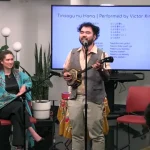
Sanjib Chaudhary, while speaking his language, Eastern (Saptariya) Tharu. Photo by Subhashish Panigrahi in CC BY-SA 4.0.
This post is part of Global Voices’ May 2026 Spotlight series, “Global crisis, local solutions.” This series will offer stories of resistance and successful climate action, insight into how communities in the Global South are fighting back against the crisis, analysis of what this might mean for future generations, and more. You can support this coverage by donating here.
Most of the Tharu community’s medicinal and cultural knowledge in the western and southern plains of Nepal and northern India has been passed down orally, from healer to healer and generation to generation. Yet this living knowledge rarely appears in archives in ways that center community voices and consent.
The OpenSpeaks Archives, launched in 2024 and hosted by the Wikimedia Foundation, is a digital language archive that supports community-based archivists in documenting, transcribing, and publishing Indigenous and low-resourced languages from India, Nepal, and Sri Lanka. As part of this work, Sanjib Chaudhary has been documenting his community’s traditional healing practices and folk knowledge through audio-visual recordings. He is a long-time Global Voices contributor, author, and Eastern (Saptariya) Tharu language activist.
This interview was conducted by Subhashish Panigrahi on behalf of Rising Voices and OpenSpeaks Archives via online call.
Rising Voices (RV): You are both documenting and archiving your community’s traditional knowledge. Could you briefly describe the project and what you hope it will achieve?
Sanjib Chaudhary (SC): As part of this project, I am interviewing Tharu traditional healers and documenting their practices in Eastern (Saptariya) Tharu. I have started with two healers from Saptari District in Madhesh Province, eastern Nepal, and I plan to reach more healers in Dang District in western Nepal and in Chitwan District in central Nepal.
I want people to see how Tharu healing systems work across this east — west geography — how the plants, remedies, and rituals change from place to place, and what they have in common. These healers prepare many important decoctions and concoctions from local medicinal plants. I hope the documentation will be useful not only to my community but also to those working in Ayurveda and other traditional systems of medicine.
RV: Why did you choose audio-visual documentation instead of purely text-based documentation?
SC: Earlier, through another grant, I had written about Tharu traditional healers in text form, but I increasingly felt that it was not enough. When we write, we lose so much: tone, rhythm, body language, and the emotion in the healer’s voice.
Many people also do not have the time or habit to read long articles; they skim. With audio and video, they can hear the healer’s voice directly instead of reading my description of them. That creates trust and credibility — people see that these are real community members speaking about their own practices, not someone speaking on their behalf.
RV: Today, many people also upload oral histories and interviews to YouTube. How is your work different from simply putting videos on YouTube?
SC: YouTube is important because many people use it, but in its current form it adds more credibility. We follow specific documentation protocols; the documentation is directly from the field and is not for commercial use but for researchers, educators, and community members. This infrastructure gives the content a different kind of credibility and longevity.
RV: How can the tools and frameworks we’ve created for subtitling, documentation workflows, and language documentation guides be useful for you and other Tharu community-based documenters? How do you plan to use them?
SC: They are very useful for community-based documenters. I am not only creating new recordings. I am also integrating them into various Wikipedia articles, enriching them with authentic audio-visual evidence from the community. This improves both the depth and credibility of those articles. I also contribute those materials to Wikisource and Wikidata. Subtitling in Eastern Tharu, Nepali, and English makes the content accessible to my own community as well as to people who do not speak Tharu but are interested in the knowledge. I call this the “media multiplier” effect—a single recording on one platform multiplies its impact across several platforms.
RV: Wikimedia projects usually avoid “original research.” Yet oral documentation like yours often contains primary knowledge that is not written anywhere else. How do you see the value of these recordings in relation to academic citation and GLAM collaborations?
SC: Often, when audio or video is uploaded to Wikimedia Commons, it only says this is the language spoken in this clip. But the actual knowledge spoken in the clip matters. I hope we archive the material properly and credit the documenters, so that future writers and researchers can use and cite such knowledge. If community members know their work will be cited and recognized, they are more likely to spend time documenting, transcribing, and annotating. It also means that the community’s own interpretations and explanations enter the record, not just the interpretations of external researchers.
RV: You mentioned concerns about how community knowledge is used. What kind of safeguards or recognition are needed to document and share the Tharu community’s knowledge?
SC: When we publish deep community knowledge—especially about medicinal practices, rituals, or other sensitive areas—we have to think carefully about where and how it is stored. The knowledge belongs to the community as a whole.
Ideally, the documentation should clearly state that this is Tharu community knowledge, recorded with consent, and that the community retains rights over reuses. If someone in the future uses our recordings, they should acknowledge that the material comes from the Tharu community and from specific healers, and follow the permissions the community has given.
RV: Looking ahead, what do you see as the long-term benefits of this documentation for the Tharu community itself?
SC: Many of our resource persons — our healers, singers, and storytellers — are growing older. Younger people in the community are often not fully aware of how rich our Indigenous culture and knowledge are. When these elders pass away without their knowledge being documented, we lose songs, healing practices, and ways of seeing the world forever. If we document these practices now, the recordings will hold knowledge for future generations. Maybe my son, or my grandchild, or any young Tharu who becomes curious about our traditions can go back to these archives and learn directly from the elders’ voices. This is not just a repository. It is a living body of knowledge kept for future generations.