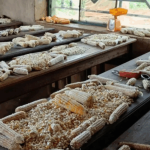
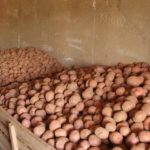
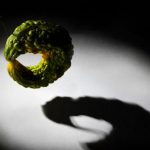
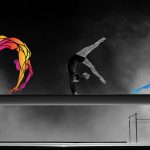
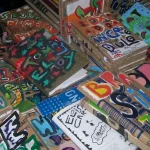
Amale Khlat, ‘Fishing on a Tridacna’ Cosmetic Vessel, 2023. 34 x 49 cm (13.4 × 19.3 in). Watercolor and archival ink on 300 gsm Arches paper. Image courtesy of the artist.
As wars, forced displacement, and humanitarian catastrophes unfold before us in an endless stream of images, the challenge is no longer simply witnessing violence, but understanding what it means to look, remember, and respond. Lebanese-British artist Amale Freiha Khlat belongs to a rare group of contemporary artists whose work resists the speed and spectacle of our image-saturated world. Instead of reproducing scenes of suffering, her installations create spaces of reflection where silence, absence, memory, and materiality become vehicles for confronting conflict. Layered, contemplative, and emotionally resonant, her visual language invites viewers into the ethical complexities of war rather than offering easy conclusions. In doing so, her work transforms spectators into participants, asking them to consider not only what is visible, but also what has been erased, omitted, or quietly accepted.
Born into a family of independent-minded Lebanese journalists and writers, Khlat grew up between Lebanon, France, and the United Kingdom. From an early age, she learned to question how news is produced, whose stories are told, and how images shape public understanding. Her childhood was marked by the Lebanese civil war, where memories of warplanes, shelling, car bombs, and constant news bulletins left a lasting awareness of loss, exile, and instability. Those experiences remain central to her practice, which increasingly addresses displacement, refugees, war, and the politics of memory through multidisciplinary installations.

Lebanese-British artist Amale Khlat in her studio in London, 2025. Photo courtesy of the artist.
Educated at Penninghen in Paris and the Royal College of Art in London, where she earned an MA in Print with distinction, Khlat has developed a practice that moves fluidly between installation, sculpture, print, video, sound, and artist books. Her works rely on concealment, reflection, theatrical distance, and material presence rather than direct representation. As she explains, “The direct image of suffering does something very specific to a viewer. It produces an immediate emotional response that closes as quickly as it opens. You feel something. Then you move on. The work has done its job and released you.” Instead, she creates works that refuse that release, encouraging viewers to remain with discomfort, ambiguity, and difficult questions long after they leave the gallery.
In this interview with Global Voices, Khlat reflects on the politics of archives and museums, the ethics of representing war and displacement, the limits of documentary images, the relationship between material, medium, and memory, and the role art can play when political language and humanitarian responses fail.

Amale Khlat’s ‘The Archive of Silence’ was created for the group show ‘The Doorway Effect’ and exhibited at The Handbag Factory Gallery, London, UK, in 2025. 210 x 210 x 185 cm (82.7 × 82.7 × 72.8 in). Engraved plywood, MDF, timber, metal, UV print on acrylic sheet, magnet, one-way mirror sheet, two chairs, a table, a photo, an archival box. Image courtesy of the author.
Excerpts from the interview follow:
Omid Memarian (OM): In “The Archive of Silence” (2025), you stage a war museum preparing an exhibition sponsored by an arms manufacturer, with two empty chairs, a folding screen, and an audience “caught in the doorway” as both witness and accomplice. Your statement describes silence not as absence, but as something reconstructed through erasure, memory, denial, and spectatorship. At a moment when wars are unfolding in real time before global audiences, how did you think through silence as an active force, something that speaks, accuses, protects, or implicates?
Amale Freiha Khlat (AFK): Silence, in this work, is not the absence of sound or speech. It is the condition that makes certain things possible. The denial that passes as dignity, the forgetting that presents itself as moving forward. The war museum in the play is not a place of silence. It is very busy, very institutional, very concerned with how things are presented. The silence belongs to what is not shown, not collected, not sponsored.
The archival box on the table holds things that cannot be displayed. A photograph. Objects. The silence around them is not emptiness; it is a decision. Someone has decided what belongs in an archive and what does not. Someone decided what a museum can say and what it cannot. The arms manufacturer’s sponsorship makes that decision visible, but the decision exists in every institution, in every collection, in every wall text that frames what we are allowed to feel.

Amale Khlat, ‘The Archive of Silence’ was created for the group show ‘The Doorway Effect’ and exhibited at The Handbag Factory Gallery, London, UK, in 2025. 210 x 210 x 185 cm (82.7 × 82.7 × 72.8 in). Engraved plywood, MDF, timber, metal, UV print on acrylic sheet, magnet, one-way mirror sheet, two chairs, a table, a photo, an archival box. Image courtesy of the author.
I am interested in the audience’s silence, too. The moment of standing before something difficult and choosing how to respond, whether to sit, to read the play, to look in the mirror, or to walk away. All of these are forms of testimony. The work does not ask you to feel a particular thing. It asks you to notice what you do when you are given the choice.
At a time when wars and genocides unfold in real time, when we consume images of suffering between one scroll and the next, silence has become both more dangerous and more complicit. “The Archive of Silence” tries to make that silence audible, to give it weight, presence, and consequence.

Amale Khlat, ‘The Testimony of a Refugee II – Que Sera Sera, Whatever Will Be Will Be,’ 2018. Various dimensions: cherry tree root, 16 amber resins, plywood, MDF, timber, screenprint on 5 acrylics, one-way mirror window film, high-definition monitor and player, headphone and school chairs. Photo courtesy of the artist.
OM: In The Testimony of a Refugee, you write that the spectacle of war is observed, directed, and performed, and you invoke Susan Sontag’s warning that “pictures don’t speak for themselves”— they require context and knowledge. How do you build that context inside the work itself, especially when the image of suffering is so often consumed quickly, emotionally, and without historical or political depth?
AFK: Sontag’s warning has stayed with me since I first read it. ‘Pictures do not speak for themselves.’ They need historical, political, ethical context, without which even the most powerful image becomes decoration, or worse, spectacle.
“The Testimony of a Refugee” tries to build that context inside the work itself, through accumulation. The cherry tree root is not labeled. The amber resins are not explained. The Mediterranean Sea engraved into the floor between the two chairs is not announced. The visitor has to arrive at these things slowly, through attention, through proximity, through the decision to sit down.

Amale Khlat, ‘The Testimony of a Refugee I – Question Time,’ 2017. Exhibited at the Cafe Gallery Project, London, UK, 2018. Various dimensions: cherry tree root, plywood, nine amber resins, school chairs and panel lights. Image courtesy of the artist.
The school chairs carry the weight of what is taught and what is not. History as curriculum. The child who was never told. This is not stated anywhere in the work; it is felt, if the visitor chooses to feel it.
The question of how suffering is consumed, quickly, emotionally, without depth, is the subject of the work, as much as its content. The tête-à-tête structure of the earlier version, with one person watching and one only listening, makes this explicit. You cannot share the same experience even when you are sitting together. Context is not something that can be given. It has to be built, slowly, by each person who enters the room.
OM: How has academic training shaped your practice, not only technically, but conceptually, in the way you approach installation, print, sculpture, video, sound, theatrical space, and the role of the spectator?
AFK: The Royal College of Art gave me permission to fail. That sounds simple, but it is not. The permission to make work that does not resolve, that does not conclude, that holds contradictions without resolving them — this is not easy to arrive at alone. The RCA gave me the critical framework and the space to test ideas until they became something I could not have predicted at the beginning.
Penninghen gave me rigor. The French tradition of drawing, of composition, of understanding the image as something constructed rather than found, which is the foundation beneath everything else. The printmaking came from the RCA, but the eye came from Paris.
What academic training cannot give you is the subject. That comes from elsewhere, from memory, from geography, from the specific experience of living between two worlds and belonging entirely to neither. The training gives you the tools. The life gives you the necessity.
Conceptually, what both institutions gave me was the habit of questioning. Not what to make, but why. Not how to make it, but what it costs to make it. That question — what does it cost to make this work, and what does it cost the viewer to receive it — is still at the center of everything I do.

Amale Khlat, ‘Mousharabiah Screens,’ 2022. Screenprints on acrylic sheets mounted on steel frames. Image courtesy of the artist.
OM: Your work moves across installation, sculpture, print, video, sound, artist books, screens, and staged spaces. How do you decide which medium can carry a subject as difficult as war, displacement, erasure, or spectatorship?
AFK: I do not choose the medium first. The medium arrives with the subject, or sometimes after the subject has been circling for a long time without finding its form.
The “Mousharabiah Screen” had to be a print. The reduction process, carving away, removing, revealing, is the subject as much as the image. You cannot separate the method from the meaning. The linocut reduction is itself an act of erasure and revelation.
The forest had to be sculpture. You cannot print a tree root. You cannot photograph the weight of wood and beeswax and steel. The materiality of the ephemeral (the cloud made stone, the forest reconstructed according to mathematical laws) requires physical presence. The viewer has to be in the same room as the object.
The screens, acrylic, mirror, one-way film, had to be transparent and reflective simultaneously. The viewer had to see themselves in the work. That is not a metaphor. It is a material requirement.
The chairs, the archival boxes, the engraved floors — these are not decorative choices. They are questions made physical. A chair without a seat cannot be occupied. A box that cannot be opened holds a silence that is louder than anything it might contain. The material is always the argument.

Amale Khlat, ‘Mousharabiah Screens, The Perilous Journey.’ newspaper series, 2018. Series of nine linocuts on newsprint. Image courtesy of the artist.
OM: One thread running through your practice is the screen: the Mousharabiah that reveals and conceals, the folding panel, the one-way mirror, the printed surface, the stage, the fourth wall. What does the screen allow you to say about looking, especially in an age when images of war, refugees, and catastrophe circulate constantly, but do not always produce understanding or action?
AFK: The screen is the condition of our moment. We live behind screens, we watch screens, we are watched through screens. The image of war, of refugees, of catastrophe arrives through a screen, framed, edited, captioned, scrolled past.
What the “Mousharabiah Screen” allows me to say is that this is not new. The mediation of looking (the screen that simultaneously reveals and conceals, that protects and withholds) is as old as architecture. The desire to see without being seen is as old as the human gaze.
What is new is the speed. The image of suffering that arrives on a screen today is gone tomorrow, replaced by another image, equally urgent, equally forgotten. The screen produces a constant present tense in which nothing accumulates, nothing sediments, nothing becomes history.
My screens slow that down. The Mousharabiah lattice requires attention. You have to look through it, not at it. The one-way mirror shows you yourself looking. The folding panel requires you to move around it, to find your position. These are not passive surfaces. They are negotiations between the viewer and what is being seen.
In an age when images of war circulate constantly without producing understanding or action, I am interested in the screen that makes you stop. That makes you aware of your own looking. That asks not only what you see, but what it costs you to see it, and what you have chosen, consciously or not, not to see at all.

Amale Khlat, ‘The Celestial Weave,’ 2025, shown at the Handbag Factory Gallery, London. 30 x 45 x 1.5 cm (11.8 × 17.7 × 0.6 in.) Twenty-four linocuts on newsprint-mounted plywood. Two unique artist’s books consisting of 12 linocuts and silk prints on Arches paper, mounted and bound in a concertina format, with a handmade cover when closed. Series of linocuts on Arches paper in archival boxes. Image courtesy of the artist.
OM: Your works seem intentionally composed to lead audiences toward awareness, sympathy, or even awakening without relying on overt imagery or direct visual shock. Instead, you use “concealment, theatrical distance, ornament, reflection, and erasure.” How did you come to trust this quieter, more layered approach, and what do you think it asks from the viewer that a more direct image may not?
AFK: I did not arrive at this approach through a theoretical decision. I arrived at it through failure, through making work that was too direct, too illustrative, too close to the image it was trying to question.
The direct image of suffering does something very specific to a viewer. It produces an immediate emotional response that closes as quickly as it opens. You feel something. Then you move on. The work has done its job and released you.
I wanted to make work that does not release the viewer so easily. That keeps them inside the question rather than delivering an answer. Concealment, distance, ornament, reflection, these are not ways of avoiding difficult subjects. They are ways of holding the viewer inside the difficulty for long enough to actually feel it.
The “Mousharabiah Screen” is the model. It does not show you everything. It shows you enough to make you want to see more. It protects, and it withholds simultaneously. The viewer has to do some of the work. And in doing that work, they become part of the piece. Their looking becomes the subject.
Trust in this approach came slowly. It came from watching audiences in the gallery space, noticing when they stopped, when they moved closer, when they sat down. The work that held them longest was never the work that shouted.
OM: As a Lebanese-British artist based in London, how do war, displacement, and the unresolved histories of the region enter your work, not as autobiography alone, but as a wider artistic and ethical question? What can art offer when political language fails, or when humanitarian response is blocked by distance, fatigue, or indifference?
AFK: Lebanon is not a subject I choose. It is the condition from which I see. The civil war was not something that happened to Lebanon while I watched from a distance. It was the air, the sound, the daily negotiation between ordinary life and extraordinary violence. You learn, very young, to hold both simultaneously.
Living in London has not changed this perspective. If anything, living here sharpened my experience of watching a war from a distance that is also intimate, of reading the news about a place you carry inside you, of navigating between a world that knows your country as a crisis and the country itself, which is so much more than that.
What art can offer when political language fails is not an answer. Political language fails because it is trying to produce agreement, consensus, action. Art does not need to produce any of those things. It can sit with the contradiction. It can hold the question open. It can make the viewer feel the weight of something they have been watching from a safe distance, without telling them what to do about it.
The distance, the fatigue, the indifference — these are not problems to be solved. They are the conditions the work has to navigate.

Amale Khlat, ‘Crafting Memory Lane 2, The Odious Smell of Truth,’ 2017. Hockney Gallery, London. Image courtesy of the artist.
OM: How have galleries, fairs, institutions, and collectors responded to works that are formally refined but emotionally and politically charged? Do you feel the art world is becoming more open to works rooted in current human suffering and historical rupture, or does it still prefer difficult subjects to arrive through abstraction, beauty, or distance?
AFK: The art world is complicated. It has always preferred difficult subjects to arrive through beauty, and I understand why. Beauty slows the viewer down. It creates the conditions for a harder encounter. I use beauty deliberately, for exactly this reason.
But beauty also protects the institution. A formally refined work about war can be collected, exhibited, and praised without the collector or institution having to take a political position. I am aware of this tension. I do not think it is resolvable. I work within it.
Whether the art world is becoming more open to works rooted in current human suffering, I am not sure. There are moments of genuine openness, usually following a specific crisis that has reached a tipping point of visibility. But openness is not the same as sustained engagement. The question is not whether difficult work can be shown. It is whether it continues to be shown, collected, and discussed after the crisis has moved off the front page.