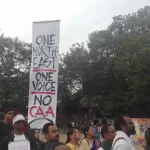
Protest in Mali against violence towards women. Screenshot from the video “Protests in Mali against violence towards women” on the VOA Afrique YouTube channel.
Since 2012, Mali has been in security turmoil with the emergence and expansion of several radical non-State armed groups: Jamāʿat Nuṣrat al-Islām wal-Muslimīn (JNIM), Al-Qaeda in the Islamic Maghreb (AQMI), Katiba Macina, Al Mourabitoun, and the Islamic State Sahel Province (EIGS). These groups demand the independence and empowerment of territories in the northern region of the country, using targeted violent action to weaken and overthrow the powers that be. The current state of affairs has led to ongoing security disruptions across Mali and other Central Sahel countries.
Today, the security situation in Mali, a member of the Alliance of Sahel States (AES) that withdrew from the Economic Community of West African States (ECOWAS) on January 28, 2024, has been marked by clashes between the Malian armed forces and their allies and non-State armed groups. This situation continues to disproportionately affect the civilian population, especially women and girls who are often victims of sexual violence.
According to the United Nations Population Fund’s (UNFPA) May 2025 Mali Situation Report, the armed groups’ attacks also result in forced marriages and considerably limit access to essential sexual and reproductive health and protection services. In the March 2025 report, UNFPA explains:
In March 2025, armed groups intensified their activities, resulting in violent clashes, which led to significant population displacement. Women and girls continue to bear the brunt of this violence, with their rights and safety increasingly at risk.
What’s more, the impact of the U.S. budget cuts makes these women and girls more vulnerable. The report continues:
However, the sudden termination of U.S. funding has caused the cessation of key humanitarian programmes, leaving thousands stranded without critical life-saving assistance, further exacerbating the vulnerabilities of populations already affected by ongoing conflicts. The impact has been particularly severe on GBV (gender-based violence) services, with over 191,000 people losing access to essential protection, and SRH services, including maternal care and family planning, which has left over 200,000 people at risk.
In addition to the violence, Mali has also suffered profound socioeconomic upheaval due in part to the massive population displacement. Although these challenges affect women and children, they are often understated in official reports.
Widely overlooked sexual violence
In Mali, in June 2025, more than 402,000 people were displaced, 58 percent of whom were women and girls. The 2024 United Nations Secretary General’s Report on Conflict-related Sexual Violence documents cases of rape, forced marriage, abduction, and sexual slavery that armed groups committed in the Gao, Ménaka (east-central), Kayes (southwest), Mopti, Ségou (south-central), and Tombouctou (north) regions, illustrating the scale and severity of these violations.
In rural areas and internally displaced persons camps, testimonies of sexual exploitation, harassment, and forced marriages are building up. Non-State armed groups exploit vulnerable communities, instilling a climate of fear and submission. International institutions have noted that this humanitarian crisis profoundly affects women and girls.
In 2025, Amadou, a Malian civil society member, was the victim of an armed robbery and a witness to the rape of women committed by armed men. He told Global Voices:
C’état un vendredi soir, vers 19h, des bandits armés ont pris d’assaut notre bus, sans qu’aucun secours n’arrive. Nous avons tout de suite compris qu’il s’agissait d’un braquage. Nous avons été tous dépouillés, et une dizaine de femmes ont été violées. La terreur et le désespoir de cette nuit resteront à jamais gravés dans ma mémoire. Je n’oublierai jamais leurs cris, leurs larmes, et ce sentiment d’impuissance totale. Cette nuit m’a montré combien il est urgent de protéger les femmes et de briser le silence face à la violence.
It was around 7 pm on a Friday evening when armed men stormed our bus, and no help came. We immediately realized this was an armed robbery. They robbed us of everything and raped ten or so women. The terror and despair on that night will be forever etched in my mind. I will never forget their screams, their tears, or that feeling of complete helplessness. That night showed me how urgent it is to protect women and break the silence on this violence.
As it is rooted in tradition, forced marriage is commonplace, especially in areas where poverty and insecurity limit opportunities. In this country, one in two girls is married before the age of 18. This phenomenon has severe consequences: interruption to education, early pregnancies, increased domestic violence, and damage to young girls’ physical and mental health.
Read: Mali’s rural communities mobilize against child marriage in defense of girls’ futures
Women’s resilience in dark times
Despite these difficult circumstances, several Malian women come together locally to break the silence. Various women’s community associations have created safe spaces, run awareness-raising campaigns, and support survivors. These initiatives are forms of resistance and resilience in the face of systemic violence.
However, these local organizations are severely under-resourced, and fragilities remain in their actions, given the immense needs. Alimata Traore, President of the Convergence of Rural Women for Food Sovereignty (COFERSA) in Mali, explained:
Les femmes restent le premier groupe social discriminé. Elles ont moins accès à la représentation politique, aux postes de pouvoir économique, à l’éducation et elles sont surtout les premières victimes de la pauvreté.
Women remain the most discriminated against social group. They have less access to education, political representation, positions of economic power, and are the primary victims of poverty.
The elimination of violence, access to reproductive health services, justice for sexual violence victims, and education for girls remain crucial.
Women and girls from Mali are at the crux of these crises. Although they are victims of a conflict through no fault of their own, they are also beacons of hope and change. Amadou added:
Certes, nous avons été dépouillés, mais ce sont les femmes qui ont survécu à l’horreur et dont la sécurité et la dignité restent profondément mises en péril. Il est urgent que les initiatives locales soient soutenues, et que les autorités écoutent les voix des femmes et leur donne les moyens d’agir pour se protéger.
Of course, the bandits robbed us, but the women are the ones who survived these horrors and whose security and dignity remain deeply threatened. It is imperative that local initiatives be supported and that the authorities listen to women and empower them to protect themselves.
The protection of women and girls shouldn’t be optional, but an absolute priority for sustainable peace in Mali.
Read our special coverage: Mali: National reconstruction under military leadership