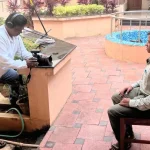
A typical example of a Creole garden. This one is tended by Hugues Occibrun, who is trying to bring back local agricultural knowledge. Photo by Olivia Losbar, used with permission.
It’s a farming model inherited from the colonial period and neglected for years, but is now enjoying a certain revival – the “Creole garden,” a traditional home garden that produces staple foods for families. Banana trees, tubers such as yams and manioc, fruit trees like avocado and mango, and medicinal and aromatic plants all cohabit in a harmonious ecosystem; any surpluses are shared with relatives and neighbours.
This system of mutual aid has helped to forge social bonds within communities, while ensuring food autonomy for the most vulnerable families, and it has often been a response to crises, be they climatic, economic or social. Today, the Creole garden is also being seen as an alternative way of countering the negative effects of climate change.
Local agriculture threatened by global change

INRAE (the French national research institute for agriculture, food and the environment) conducts an experiment with researchers and farmers in Guadeloupe. Photo by Olivia Losbar, used with permission.
According to the French national research institute for agriculture, food and the environment INRAE Antilles Guyane, which conducted a survey on the impact of the pandemic on Caribbean agriculture, this period of crisis demonstrated the resilience of local farmers, thanks in part to local and traditional practices. It also raised public awareness of the need to change consumption patterns and return to subsistence farming.
When asked about the impacts of climate change on Caribbean agriculture, Director of the Unité de Recherches AgroSystèmes Tropicaux (ASTRO) Jean-Marc Blazy notes, “The main impacts of climate change that we are observing in the region are mainly a reduction in production, which is explained by a decrease in agricultural yields, which is linked [mainly to] catastrophic events such as hurricanes or floods.”

Director of the Unité de Recherches AgroSystèmes Tropicaux (ASTRO), Jean-Marc Blazy, makes a presentation on a farm in Guadeloupe. Photo by Olivia Losbar, used with permission.
Such events are often associated, and can lead to the destruction of crops. Some yield reduction is also due to heat and drought, which cause plants to struggle and flower less because of the lack of water. However, Blazy says these are not the only reasons for production decreases: “With climate change, there is [less of a] difference in temperature between night and day, since warming is more marked at night than during the day. This is known as nycthemeral amplitude, and these temperature differences are important for flowering. Less flowering also means less fruit, and therefore less harvest.”
Rethinking agriculture from a perspective of justice and resilience
Faced with these challenges, INRAE, in partnership with an array of like-minded groups that include CIRAD, the University of the West Indies, and the Chamber of Agriculture, along with other local authorities and government departments. Météo France, the French national meteorological and climatological service, has also established initiatives to help reconcile modernity with local cultural heritage.
The EXPLORER programme aims to make the most of the know-how of Creole gardens, combining it with modern technologies, like weather stations and bio-inputs, to boost farms’ climatic resilience. Farmers also get whatever support they require to make the transition to agro-ecological farming.

Some of the modern technologies being used, thanks to the KARUSMART programme, to help support Guadeloupean farmers as they make the transition to agro-ecological farming. Photo by Olivia Losbar, used with permission.
According to Blazy, “There are many farming practices that need to be adapted to all these hazards.” He mentions everything from reviewing crop calendars (to reduce the risk of exposure to climatic hazards) to increasing agro and biodiversity on farms. Diversity, he maintains, is a factor of resilience – the more species you have, the better. This way, plants are better able to provide mutual protection so that if a hazard affects one plant, it won’t necessarily affect another.
“To maximise production,” he adds, “we need to return to a high level of varietal diversity; to mixes of species […] We also need to look for synergies between crops and livestock.” Such practices are at the heart of the Creole garden, which is inspiring the move towards greater agricultural diversity. For Blazy, innovation also lies in helping farmers make better planting and harvesting choices, in order to minimise the overlap between the crop cycle and climatic hazards.

Drone shot that shows the diversity on one of the KARUSMART farms in Guadeloupe. Image courtesy Olivia Losbar, used with permission.
Such initiatives are a reminder that sustainable agriculture cannot be dissociated from historical and social realities. By promoting ancestral practices like mixed farming and species association, they reinforce not only food security, but also social and environmental justice.
Agriculture in transition

Agricultural engineer Hugues Occibrun wants to preserve the Creole garden. Photo courtesy Occibrun, used with permission.
These contemporary challenges are prompting many Guadeloupean farmers to rethink their economic and ecological model, with many now working to restore these ancestral farming practices.
For Hugues Occibrun, preserving the Creole garden has become his hobbyhorse. Trained as an agricultural engineer, he was concerned by the disappearance of local agricultural know-how and decided to raise awareness of the need to maintain it. Along with Astrid Grelet, he co-founded 100%Zeb, an agricultural cooperative offering training, workshops and sales of medicinal and aromatic plants endemic to the Caribbean.
In his garden, which boasts over 300 species, Occibrun regularly welcomes anyone curious to discover (or rediscover) Caribbean pharmacopoeia. He teaches them to recognize atoumo, a medicinal plant renowned for boosting the immune system and traditionally used to combat flu-like illnesses or relieve joint pain; to discover the virtues of vetiver for soothing gynaecological pain; and even cleomea, whose tangy taste enhances the flavour of salads.

A view of Occibrun’s store, which is part of his Creole garden. Photo by Olivia Losbar, used with permission.
Occibrun is convinced that this spirit of solidarity can also help combat the impacts of climate change. “I’ve lived it,” he says. “I’ve seen every crisis we’ve had here, whether it was the LKP in 2009 [the social and societal crisis denouncing the economic monopoly exercised by large groups comprising descendants of colonists], or COVID. When people stop, what do they naturally return to? Their surroundings. And what surrounds us is the Creole garden.”
He believes that people “just want to put down roots; rediscover a bit of their Creole and Caribbean identity,” but also to spend less. “Above all,” he reveals, “there’s a real ecological desire to limit waste; to compost.” Occibrun explains that when imported products don’t arrive in the country as planned, living gets complicated: “It’s a whole way of life that we’re questioning.”

Some of the Caribbean botanicals that Hugues Occibrun derives from his Creole garden. Photo by Olivia Losbar, used with permission.
Through this work with the local population, as well as through collaborations with research organisations, and participation in festivals and other events, the cooperative’s approach to transmitting its message is wide-ranging. By all accounts, Guadeloupeans have been very receptive.
“The younger ones are very curious about learning,” Occibrun says. “As for the older generation, they’re very moved to see the Creole garden at this level. I’m happy to be part of it.” He and his team spend “a lot of time” in schools and leisure centres, where they can impart this knowledge to children in the hope of influencing future generations and thereby change the culture.
While the Creole garden advocate insists that the Guadeloupean population is ready to make this lifestyle change, he says it must be accompanied by “a real political vision.” Other organic farmers and activists like Steve Selim and Yvelle Nels have also become leading figures in adopting environmentally friendly farming practices and fair distribution systems.
A way forward: solidarity beyond borders
According to Blazy, solidarity is key to success and must be part of a more global approach. From his research background, he knows that there is a regional dynamic of knowledge-sharing, notably through the INTERREG CambioNet project, which brings together Caribbean and South American partners to exchange agro-ecological know-how.

Sheep on a farm on Guadeloupe. Photo by Olivia Losbar, used with permission.
International collaborations are also happening between Caribbean researchers and scientists from Brazil and Africa, though Blazy says that both the legislation and the economies of these territories often hamper progress.
In a context marked by climate change, high living costs and global crises, however, this solidarity offers a sustainable and humane response to contemporary challenges.
Thanks to activists, innovative initiatives and ancestral practices, Guadeloupe is charting an ambitious course towards food sovereignty, and reconciling its past, present and future into the bargain.