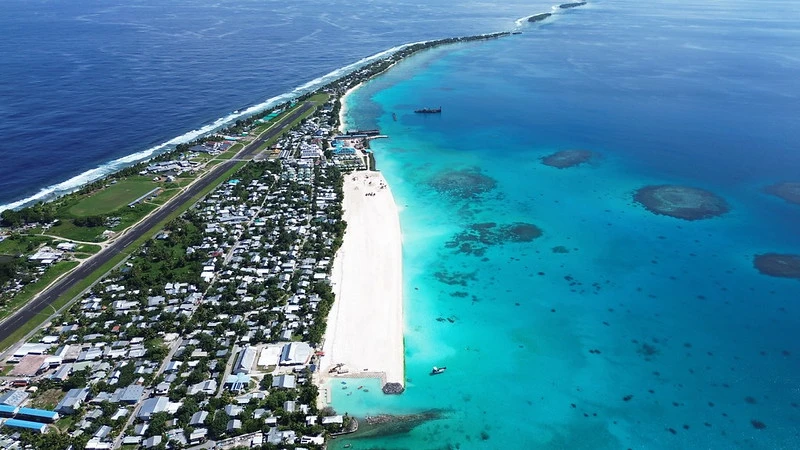
An aerial view of Tuvalu’s coastal adaptation project. Photo from the UNDP Climate Flickr page. CC BY-NC 2.0
This post is part of Global Voices’ May 2026 Spotlight series, “Global crisis, local solutions.” This series will offer stories of resistance and successful climate action, insight into how communities in the Global South are fighting back against the crisis, analysis of what this might mean for future generations, and more. You can support this coverage by donating here.
What happens to a country without land?
This is the question that inspired the launch of Tuvalu’s Digital Nation project amid rising sea water levels and the worsening impact of climate change.
Tuvalu, which has a population of around 12,000, is a Pacific nation made up of low-lying atolls. As the climate crisis worsens and ocean levels rise, Tuvalu is at risk of being submerged by the seas over the next 100 years.
In 2021, Tuvalu’s then-Foreign Minister, Simon Kofe, addressed the Conference of the Parties 27 (COP26), the world’s largest annual climate conference, from a podium while standing knee-deep in seawater to dramatize how small nations with historically low carbon emissions suffer the most from climate change.

Tuvulu’s Foreign Minister delivers an address to COP26, while standing in knee-deep water to illustrate how rising sea levels threaten Pacific nations. Image from Simon Kofe’s Facebook. Fair use.
The following year, he announced during the COP27 that Tuvalu would become the first Digital Nation:
This digital transformation will allow Tuvalu to retain its identity and continue to function as a state, even after its physical land is gone. It will also facilitate the governance of a Tuvaluan diaspora by creating a virtual space where Tuvaluans can connect with each other, explore ancestry and culture, and access new opportunities for business and commerce in various industries. Moreover, a permanent digital replica of Tuvalu — a new ‘defined territory’ — will aid in the fight for continued sovereignty under international law.
The project has three major components: 1) Digital Twin, which involves the scanning of 124 islands and islets to make a digital copy of the land of Tuvalu; 2) Digital Ark, a cloud platform for digital and 3D scans of important Tuvaluan objects, values, and stories; and 3) E-government services for Tuvalu “to ensure improved access for Tuvaluans while also allowing the government to function virtually in a worst-case scenario where people are forced to leave Tuvalu because of climate change.”
This is a large-scale project that seeks to mobilize the whole population. Consultations are crucial for securing public support and ensuring that the most valuable cultural resources are preserved.
Digital Nation in Nui 🌊
The team continues consultations today, meeting communities & students to hear their views on the project and what should be preserved in the Digital Ark.
Final stop next: Vaitupu ➡️#DigitalNation #Tuvalu pic.twitter.com/WRxHXOQ1Pg— Digital Nation Tuvalu (@digi_nation_tv) April 22, 2026
After attending workshops and consultations about the project, the people of Tuvalu themselves are charged with identifying the stories and cultural practices they want to digitize. For example, a resident wanted to document the art of canoe making.
Another resident wanted to promote the knowledge of making Ano, the ball used in a traditional Tuvaluan sport.
In another workshop, 3D scans of pulou (traditional woven hats) and pillows were made
In an interview with this author, the team behind the Digital Nation shared the status of the project.
We are in the middle of Outer Islands consultations promoting and explaining the project to Tuvalu’s Outer Islands communities.
When we are digitizing stories of Tuvaluan objects, values, and practices in the Digital Ark, we have to make sure that the people who store their data are fully protected and we also have to ensure that Tuvalu hosts, houses, and maintains sovereignty over the platforms that support this data.
They also enumerated some of the lessons from implementing the project:
- The importance of closely collaborating with all departments who work on digitization in the Government of Tuvalu (there are a lot!) to gather best practices and ensure a streamlined approach to digital futures.
- The strong appetite for digital and cultural preservation, especially among youth in Tuvalu.
- The vast range of objects, values, stories, and practices communities want to digitize.
- The need for different levels of security in digital platforms like the Digital Ark to ensure that people can digitize objects and stories but also ensure that access to those objects and stories can be limited if the people who digitize the objects and stories request that only their family members or specific community can have access.
Since the project relies on internet connectivity, there are concerns about the resources it will require and consume, as well as the risk of cyberattacks.
Some also criticize that the project implies officials have accepted that Tuvalu will inevitably disappear from the maps.
Writing for the DevPolicy blog, Venu Edwin Pedro and Jess Marinaccio addressed this issue and asserted that the project carries the message of hope — not resignation.
The Digital Nation represents the hope that Tuvalu can prepare for extreme climate impacts, with its culture and government services fully protected in the face of rising sea levels and other disasters
It is about being proactive in the face of climate change and other influences and preserving culture for a better tomorrow.
Digital Nation is an investment in improved connectivity and e-services that can help citizens buy inter-island boat tickets, renew passports or obtain marriage certificates online rather than travelling great distances to do so in person. It is a story of staying in Tuvalu — not leaving it.
Venu, a native of Tuvalu, highlighted how the project inspired greater appreciation for the nation’s cultural resources.
To me, the Digital Nation is a new way to fight, adapt and protect our identity and sovereignty. It is about taking control, shaping our future and keeping our roots alive.
As someone who does not want to migrate, the project is a beacon of hope and a way for Tuvaluans to solve the problems they face without relying on others.
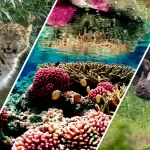
The Digital Nation complements other initiatives aimed at countering the harsh impact of climate change, such as land reclamation and coral restoration in Tuvalu.
It also sends an important message to the global community that urgent action is needed to stop the loss of small island states like Tuvalu.
A small nation like Tuvalu is forced to replicate itself in the metaverse because of the continued slow response, inaction, and failure of nation-states and global institutions to implement a sustained program of action to reduce and combat the adverse effects of fossil fuel emissions.
In other words, the Digital Nation project may be focused on preserving Tuvalu, but its global significance should be underscored as well.